How US Buyers Should Evaluate Asian AAMI Level 4 Gown Manufacturers
How US Buyers Should Evaluate Asian AAMI Level 4 Gown Manufacturers requires a clear plan to check Asian AAMI Level 4 gown makers. Focus your checks on four main areas: rules, material performance, manufacturing quality, and shipping. This process stops fake or poor products from reaching the operating room. The market for high-level protection keeps growing, and demand for AAMI Level 3 medical supplies keeps rising. That growth makes careful choosing more important than ever. You must prove every claim about surgical gowns before you sign a contract. This article gives you real steps and clear rules to follow. You can protect healthcare workers and patients with the right supplier. Strong safety rules start with checked personal protective equipment. Your healthcare facility deserves nothing less.
Key Takeaways
Check FDA 510(k) clearance and registration on the official database.
Require third-party ASTM F1671 test reports for the whole critical zone.
Do factory checks from far away using live video of the production lines.
Ask for production samples to be sent for independent lab testing.
Check that the supply chain is dependable, delivery times are clear, and customs records are in order.
Do not accept test data from the factory itself; use only reports from accredited labs.
Check social compliance certificates like BSCI by doing proper audits.
How US Buyers Evaluate Asian AAMI Level 4 Gown Manufacturers
Understanding the Four Core Evaluation Areas
You need a clear plan to judge any maker from another country. Four areas matter most. Each one shows a different risk. Together, they give you the full picture of whether the supplier can deliver safe, effective protection.
Regulatory Compliance and FDA Requirements
The FDA treats surgical gowns as Class II medical devices. A real maker must have 510(k) clearance for each gown model it sells in the United States. You should check the clearance number yourself on the FDA database. Make sure the maker name and device description match the product you plan to buy. Any mismatch is a serious problem. The maker must also keep establishment registration and list its devices with the FDA. These steps prove the company works legally in the US market.
Material Performance and Independent Testing
AAMI Level 4 is the highest barrier against blood and viral penetration. The fabric and seams must pass ASTM F1671, which tests resistance to phi-X174 bacteriophage. You should ask for test reports from accredited third-party labs. In-house data alone cannot prove performance. Look for hydrostatic head results and seam strength values. These properties decide how well the gown resists liquid strike-through during long surgical procedures. The material grade also matters. SMS fabric and microporous film each offer different levels of comfort and protection.
Quality Control and Factory Audit
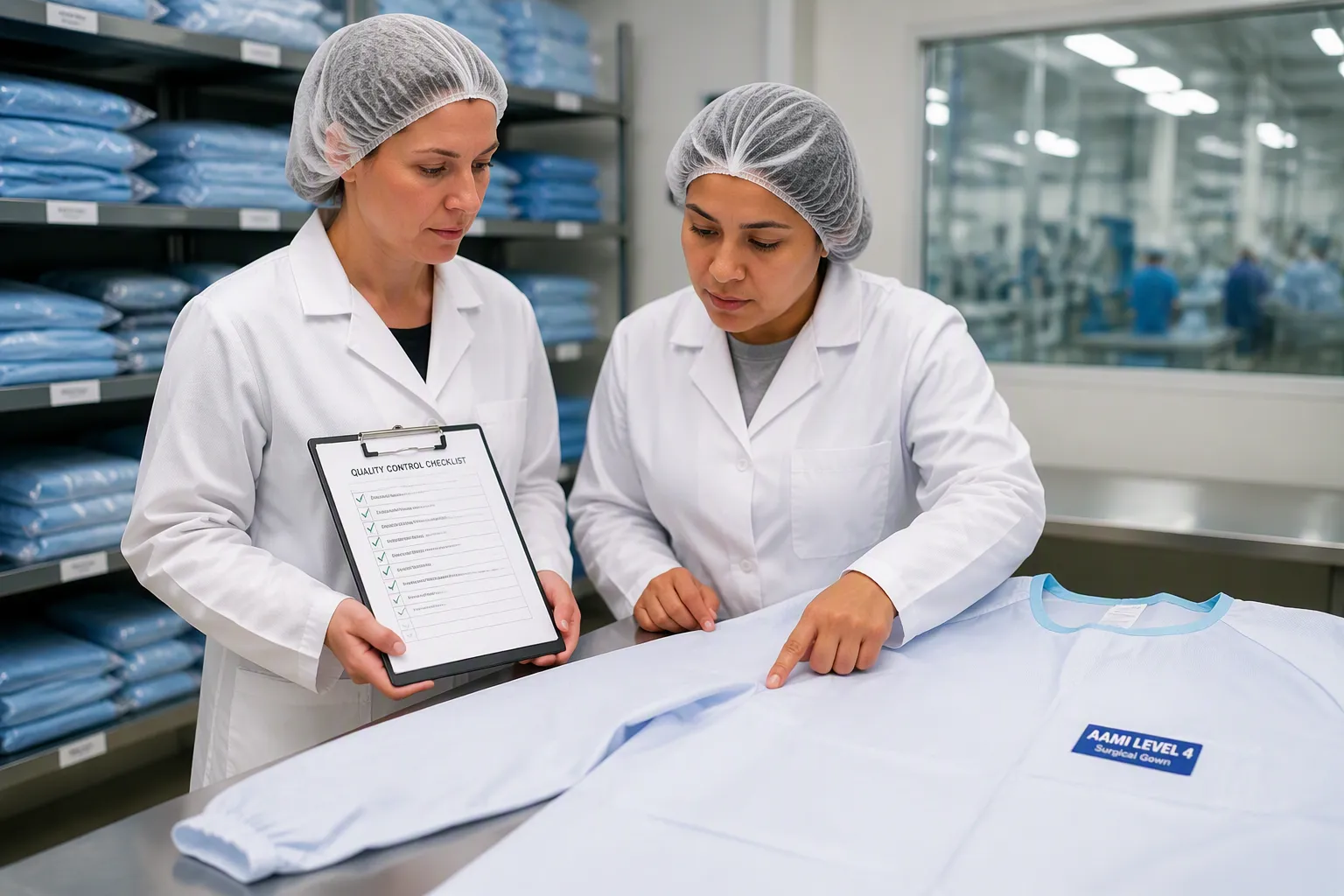
You cannot trust a certificate alone. You must audit the factory. A cleanroom environment with ISO Class 7 or 8 classification is essential for making sterile-barrier surgical gowns. The maker should do in-process inspections and lot release testing. Ask for records that show how they handle defects. A strong quality system catches problems before shipment. A weak one lets them reach your hospital.
Supply Chain Reliability and Logistics
Even a perfect gown fails if it arrives late. You need to check production capacity, lead times, and shipping routes. Ask the maker for a volume commitment. Confirm they can handle your peak demand. Understand their customs compliance history. Delays at the port or missing paperwork can stop your entire supply. A reliable supplier plans for disruptions and communicates openly.
Why a Structured Evaluation Is Critical
A structured process protects you from costly mistakes. It forces you to verify every claim. It also creates a record you can use if problems come up later.
Protecting Patient Safety and Hospital Reputation
Substandard surgical gowns put healthcare workers and patients at risk. A gown that fails ASTM F1671 lets viruses pass through. That failure can lead to infection. It can also harm your hospital’s reputation. News of a safety breach spreads fast. Patients trust your facility to protect them. That trust depends on the integrity of every piece of personal protective equipment you buy. A structured evaluation keeps unsafe products out of your operating rooms.
Avoiding Costly Supply Disruptions
A cheap gown becomes expensive when it fails. You may face returns, replacements, and emergency purchases at premium prices. A supplier who cannot deliver on time forces you to scramble. That scramble costs money and staff time. It also risks canceling surgeries. A structured evaluation finds weak suppliers before you sign a contract. You can negotiate better terms with a proven partner. You can also build a backup plan. The cost of due diligence is small compared to the cost of a failed supply chain.
When you evaluate a maker for custom medical clothing or standard surgical gowns, you must apply the same rigor. The same standards apply whether you source from a large medical uniform suppliers company or a smaller specialist. Your sourcing decisions affect patient outcomes. Treat every evaluation as a safety-critical task.
Understanding AAMI Level 4 Surgical Gowns
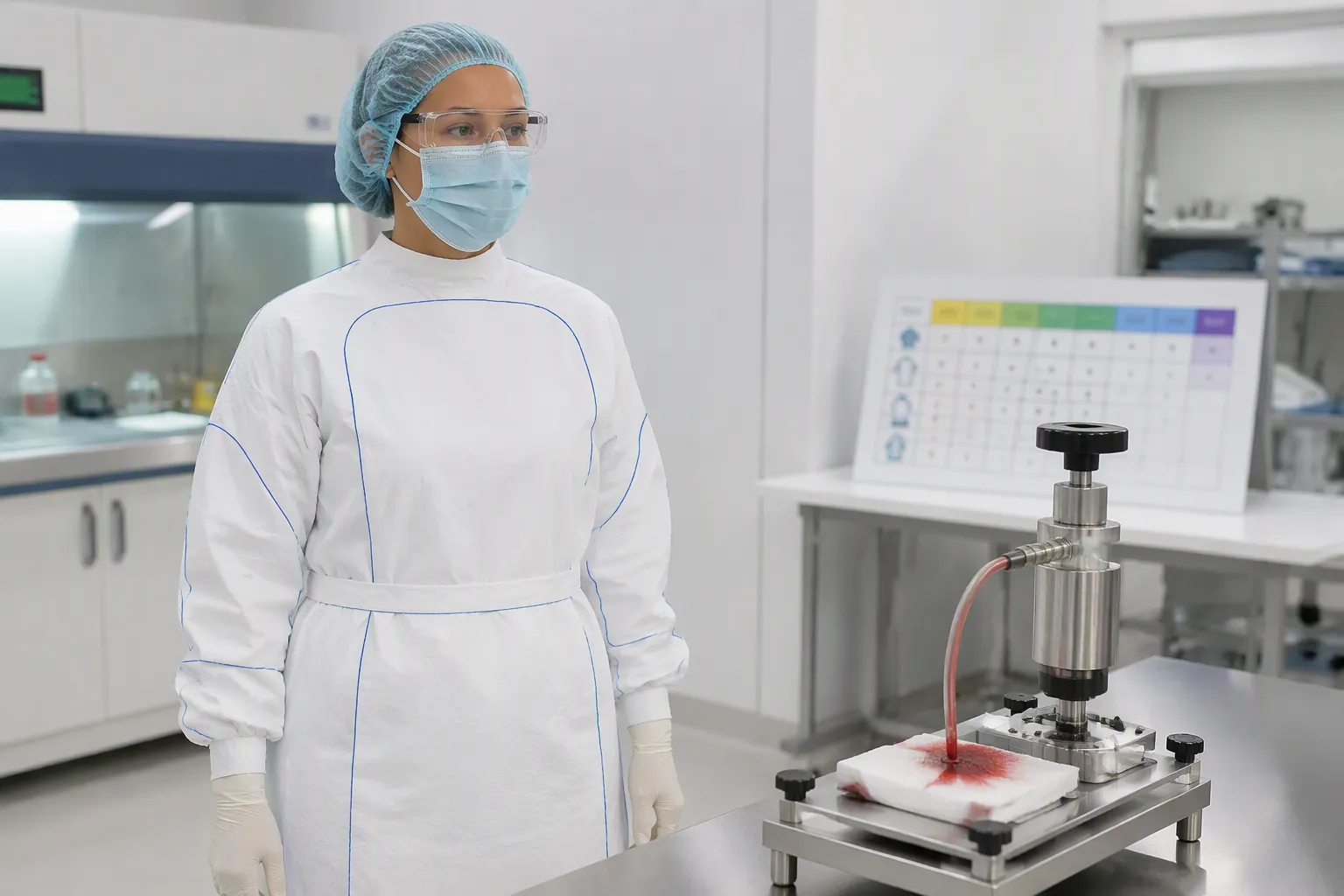
AAMI Level 4 is the top barrier class for surgical gowns. The ANSI/AAMI PB70 standards give clear rules that define protection levels in four groups. You must know these rules to judge manufacturers the right way. Level 4 calls for viral penetration testing under pressure. Lower levels only test water resistance. You need Level 4 surgical gowns for high-risk procedures. Your medical facility relies on correct classification.
AAMI Protection Level Classification
The ANSI/AAMI PB70:2012 standard sets four levels of barrier performance. You should use these rules for any medical gown evaluation.
From Level 1 to Level 4
Level | Barrier Protection | Governing Test Method(s) |
|---|---|---|
Level 1 | Minimal — resists water impact only | AATCC 42 |
Level 2 | Low — resists water impact and light hydrostatic pressure | AATCC 42 and AATCC 127 |
Level 3 | Moderate — resists higher hydrostatic pressure | AATCC 127 |
Level 4 | High — resists synthetic blood and viral penetration under pressure |
Level 4 is not the same as Levels 1 through 3. Only Level 4 uses a pathogen surrogate for testing. This makes Level 4 the right class for personal protective equipment against blood-borne pathogens. Lower levels give splash protection only. You need this protection for high-exposure cases. Reusable surgical gowns also need Level 4 classification for viral protection testing.
Critical Zones Required for Level 4
The standard does not require the whole gown to meet Level 4 barrier performance. Critical zones define the areas that must pass testing. These zones cover the front panel and sleeves. The back of the gown gives no barrier protection. You must confirm that the critical zone materials meet the requirements.
The classification of the entire surgical gown under the AAMI Standard is based on the lowest level of protection within any of its Critical Zones.
This rule means one weak seam can lower the gown’s classification. You must check that the manufacturer tests both fabric and seams. Seam construction matters for barrier performance. Bound, taped, or ultrasonically welded seams hold better than simple stitched seams. Look for test reports that cover the whole critical zone. A report that tests only fabric does not prove the gown meets Level 4.
ASTM F1671 Viral Penetration Test
ASTM F1671 is the key test for Level 4. This testing standard measures resistance to viral penetration. Manufacturers must prove their products pass this test.
Test Protocol and Pass Criteria
ASTM F1671 uses Phi-X174 bacteriophage as a surrogate microbe. This virus is close in size to HCV, HBV, and HIV. The test applies continuous liquid contact at 2 psi. A pass result means no viral penetration occurs. Only products that pass ASTM F1671 are viewed as impermeable to viral penetration.
Only gowns that pass ASTM F1671 are considered impermeable to viral penetration, and are defined as Level 4 garments.
You should ask for the complete test report. Look for the pass result. Check that the report includes critical zone materials. Verify the lab is accredited. In-house data does not prove the barrier claim. You need third-party validation for healthcare safety.
Common Testing Misconceptions
Many Asian manufacturers give incomplete test reports. Some test only fabric samples. Others test only one area. A valid report must test the whole critical zone. Seams and attachments must pass the same ASTM F1671 test. Watch for reports that use outdated standards. ASTM F1671-13 is the current version. Older versions may not reflect current requirements. Third-party validation from accredited labs gives the most reliable proof. Never accept in-house data alone. Sterile surgical gowns require complete testing for medical safety. The cost of independent verification is small compared to the medical risk.
Regulatory Compliance and Quality Standards for Manufacturers
FDA 510(k) Clearance and Establishment Registration
Premarket Notification Process
The FDA puts AAMI Level 4 gowns into Class II medical devices. This means you need a 510(k) notice before you can sell them in the US. Your supplier must show proof that the gown follows ANSI/AAMI PB70 rules for protection. The proof must have tests on the final product at the end of its storage time. For gowns you can use many times, the maker must test protection at the end of its use life. The 510(k) must have design drawings. These drawings show protection levels, sizes, and where important and less important areas are. Product labels must show the protection level clearly using AAMI PB70 rules. They must also include how to use the gown and when to use it. The FDA gives more rules, like the 2023 Premarket Notification Requirements for Gowns and the 1993 Guidance on 510(k) Submissions for Surgical Gowns and Surgical Drapes. You should also look at the Use of International Standard ISO 10993-1 for biological testing.
Verifying Registration on the FDA Database
You can find FDA-approved gowns by looking in the 510(k) database. Use codes FYA, FYB, FYC, and QPC. Check the storage time and expiry date on labels. Do not use expired gowns for protection. Always check the maker’s name against FDA records. If they do not match, that is a big problem.
ISO 13485 and International Quality Management
Role of MDSAP Certification
ISO 13485 is a quality management standard that makers choose to follow. A separate group gives the certification, not ISO. This certification alone does not allow selling a device. The FDA Quality Management System Regulation includes ISO 13485:2016 in its rules. It keeps US-specific legal needs and starts on February 2, 2026. A maker selling in the US must follow QMSR, not just have an ISO 13485 certificate. MDSAP adds rules from different countries to ISO 13485. This program is important for makers selling to Canada, Australia, Brazil, Japan, or the US.
CE Marking for Dual-Market Suppliers
A medical clothing maker that sells to both the US and Europe needs CE marking. This mark shows they follow European rules for medical devices. You should check that the CE certificate covers the gown model you want to buy. A maker with both FDA clearance and CE marking gives you more options. This double approval lowers your risk when you switch between markets.
Evaluating Material Performance and Testing Reports
Key Material Properties for Barrier Protection
Hydrostatic Head and Seam Strength
You might think AAMI Level 4 surgical gowns need a certain hydrostatic head pressure. They do not. Hydrostatic head testing is only for Levels 1 through 3. Level 4 protection comes from passing ASTM F1671, which tests resistance to blood and viral penetration at 2 psi. This difference matters when you look at what suppliers claim. A maker who uses hydrostatic head values as proof of Level 4 performance does not understand the standard.
Seam strength still affects the overall barrier. ASTM F2407 is the main standard for surgical gown testing. It covers seam strength, tear resistance, lint generation, evaporative resistance, and water vapor transmission. The standard does not give exact seam strength values for Level 4. You should still ask for seam testing data. Weak seams let liquids through. A gown with strong fabric but poor seams fails at its job.
Non-Woven Fabric Grades (SMS, Microporous Film)
Fabric construction decides comfort and barrier stability. Standard SMS fabric often needs a heavier weight to meet fluid resistance thresholds. That heavier weight makes it feel stiff, like cardboard. SMMS fabric with two meltblown layers gets similar fluid resistance at a lighter weight. The result is better flexibility and barrier stability. This comparison shows how the number of meltblown layers affects performance.
Microporous film options include coated polypropylene (PP+PE) and polyethylene (PE) film. Coated PP+PE combines soft spunbond polypropylene with a polyethylene film layer. PE film uses a single polyethylene layer for protection at a lower cost. Each option fits different clinical needs. You must match the fabric grade to your intended use.
Independent Lab Reports vs. In-House Data
How to Verify Report Authenticity
You cannot trust in-house data alone. Third-party validation from accredited labs gives reliable proof. Ask for the lab name, accreditation number, and test date. Contact the lab directly to confirm the report. A supplier who refuses this step is a red flag. The FDA and other guidelines expect independent verification for medical devices.
Essential Elements in a Valid ASTM F1671 Report
A valid ASTM F1671 report must include several elements. Check that the report tests the whole critical zone, not just fabric samples. Seams and attachments must pass the same test. Verify the standard version is current. Look for the pass result and the lab’s accreditation. The report should cover sterile surgical gowns and reusable surgical gowns alike. Without these elements, the report does not prove Level 4 performance. Your healthcare facility needs complete documentation before you approve any supplier.
Factory Audits and Supply Chain Reliability
Quality Control in Cleanroom Environments
ISO Class 7 or 8 Cleanroom Classification
You must check the factory setting before you trust any protection claim. AAMI Level 4 surgical gowns must be made in controlled spaces. The factory audit should prove ISO Class 7 or 8 cleanroom classification. These classes limit tiny particles in the air that could dirty the final product. Ask for the cleanroom certificate and check its expiration date. A maker who cannot show this paper fails a basic rule.
In-Process Inspections and Lot Release Testing
Good quality systems catch problems during production, not after. You should ask for records of in-process checks at each step. The maker must also do lot release testing before shipping. This final product check proves that every batch meets the barrier standard. Ask how they deal with failed batches. A supplier with clear fix-it records shows real care for medical safety.
Social Compliance and Ethical Manufacturing
BSCI, SA8000, or SMETA Audits
US buyers now often require social compliance certificates from Asian suppliers. The table below compares common choices for your sourcing decisions.
Certification | Origin / Leadership | Audit Type | Commonality with US Buyers Sourcing from Asia |
|---|---|---|---|
WRAP | US-recognized, aligned with US labor law expectations | Factory-floor conditions certification based on 12 principles | Most requested by mid-to-large US brands and department stores |
BSCI | European-led initiative | System audit (management systems for ethics, e.g., grievance mechanism, HR policy) | Popular with European brands but increasingly required by US brands sourcing from multiple Asian countries |
SA8000 | Based on International Labour Organization (ILO) standards | Outcome audit (requires demonstrated year-over-year performance improvement) | Less common but considered more stringent and rigorous |
You should also look for ISO 9000, WRAP, and BSCI when you check a maker. These certificates show that the factory follows fair labor practices.
Labor Practices and Tracing Raw Material Sources
You need to know where your gown materials come from. Ask the maker to trace raw material sources for every part. This step matters for reusable surgical gowns and custom medical clothing alike. A supplier who cannot document their supply chain is a hidden risk. You should also review labor practice records. Fair pay and safe working conditions lower the chance of problems.
Assessing Production Capacity and Logistics
Lead Time and Volume Commitment
You must confirm that the maker can meet your peak demand. Ask for a written volume commitment. Request their normal lead time and their capacity during busy seasons. A supplier who promises too much will fail you when you need protection most. Plan your orders around their real production limits.
Shipping Routes and Customs Compliance
Logistics failures can stop your whole supply. You should understand the shipping routes your supplier uses. Confirm their customs compliance history. Missing paperwork or port delays create costly problems. A reliable maker plans for disruptions and communicates openly. Your healthcare facility depends on a steady flow of personal protective equipment. Choose a partner who treats shipping as seriously as production.
Step-by-Step Verification Process for US Buyers
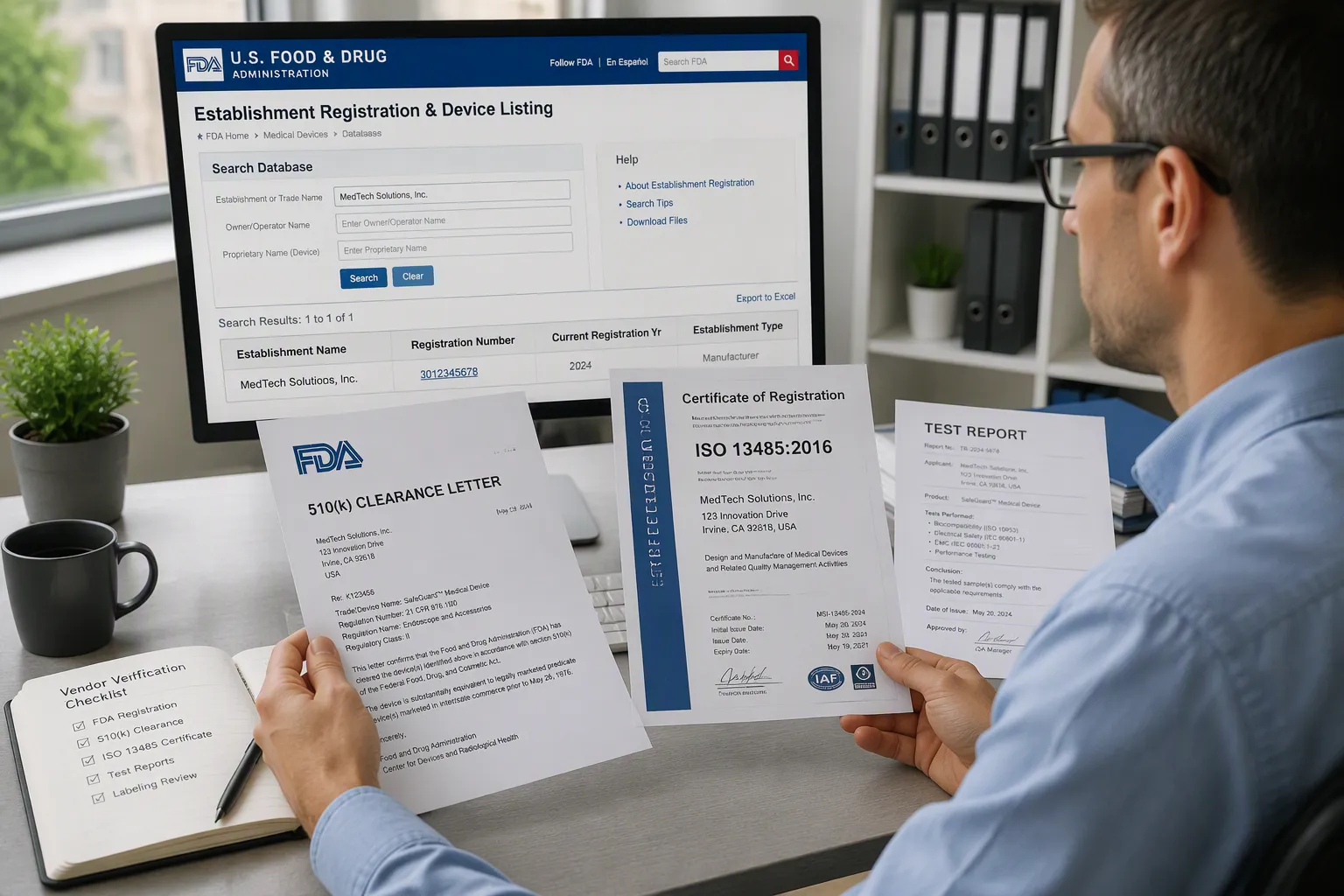
You need a clear order of steps to check any Asian AAMI Level 4 gown maker. This process keeps your medical facility safe from bad products. Follow these steps in order. Each step builds on the one before it.
Document Review Checklist
Requesting FDA 510(k) Numbers, ISO Certificates, and Test Reports
Start your sourcing by asking for a full set of documents. Ask for these items before you talk about price or production plans:
ISO 13485 certificates from the manufacturer
ASTM F1671 test report
AAMI PB70 barrier report
Technical datasheet
Declaration of conformity
Dimensional drawing
A serious supplier gives you these documents right away. A maker who waits or gives you only some papers is a warning sign at once. You need every document to prove the gown meets AAMI Level 4 rules.
Cross-Referencing Manufacturer Name with FDA Registration
You must check the supplier’s FDA registration on your own. Do not take a screenshot or a PDF copy. Open the FDA Establishment Registration and Device Listing database at accessdata.fda.gov/scripts/cdrh/cfdocs/cfRL/rl.cfm. Search using the supplier’s registered legal manufacturing entity name, not its brand name. A supplier who cannot give its exact registered entity name is already a red flag. Confirm the establishment shows up as an active registration. Open that establishment’s record and review its device listings for US commerce. Match the listed device types to the exact product you plan to order. A registration for ECG cables does not cover surgical gowns.
The FDA does not issue FDA Registration Certificates. Any certificate a supplier shows is self-generated and proves nothing. Only the official FDA databases confirm real status.
Check the most recent annual-renewal fiscal year. A lapsed registration can make a device misbranded under section 502(o) of the FD&C Act if it is still sold in the US. Read every establishment type on the record. One record can list multiple roles such as designs, builds, sterilizes, relabels, or imports. Match each role to duties like design controls, complaint handling, MDR, and corrections or removals. For foreign establishments, confirm a single current US agent is named. For imported devices, confirm the initial importer is registered and handles complaint intake.
Remote Audits and Virtual Inspections
Live Video Walkthroughs of Production Lines
You cannot visit every factory in person. Remote audits give you real-time proof of production conditions. Set up a live video walkthrough of the production lines. Ask the supplier to show you the full manufacturing process from fabric cutting to final packaging. Watch for cleanroom entry steps, worker attire, and material handling practices. A supplier who refuses a live walkthrough or offers only edited videos makes you doubt their operations.
Photo and Video Evidence of Cleanroom Conditions
Ask for dated photos and videos of the cleanroom environment. Look for ISO Class 7 or 8 classification certificates on the wall. Ask for footage of in-process inspections and lot release testing stations. These visual records add to your document review. They show whether the factory really follows the quality systems it claims.
Sample Orders and Third-Party Testing
Ordering Production Samples (Not Showroom Samples)
You must test what the factory really makes, not what they display. Order production samples from a normal manufacturing run. Showroom samples often get special care that regular orders do not. A supplier who refuses to give production samples should be dropped right away. This refusal shows they cannot meet their own claims at scale.
Sending Samples to Accredited Labs (Nelson Labs, SGS, etc.)
Send your production samples to an accredited third-party lab. Nelson Labs, SGS, Bureau Veritas, and TÜV all do ASTM F1671 testing on surgical gowns. Nelson Labs states that its staff helped develop the test method and that it has more experience in medical viral penetration testing than any other company.
Third-party laboratory testing (ASTM F1671, AATCC 42/127) must be available for every barrier level. Treat suppliers who provide in-house test results without independent confirmation as a red flag.
The ASTM F1671 test uses Phi-X174 bacteriophage at a concentration of at least 1.0 x 10^8 plaque-forming units per mL. The pass rules require zero penetration at 2 psi. This is the single most important lab test for high-risk surgical gowns. The whole verification process can take four to eight weeks. Plan your sourcing timeline around this fact. Never skip the verification process for custom medical clothing or standard surgical gowns. Your healthcare facility depends on the integrity of every gown you procure.
You now have a full plan for how US buyers should check Asian AAMI Level 4 gown makers. Four main parts hold it up: rules, material testing, factory quality, and shipping. Each part keeps your medical supply chain safe from weak spots. Testing samples on your own is still the best way to prove Level 4 works. Send production samples to a trusted lab. Never trust in-house data by itself. This step tells real protection apart from empty claims.
Your healthcare team counts on checked surgical gowns. Every surgery decision rests on that trust. Build a standard supplier scorecard using the rules in this article, and never skip the checking process. Patient safety depends on the quality of every gown you buy.
FAQ
What makes AAMI Level 4 different from Level 3 barrier protection?
Level 4 must pass ASTM F1671 viral penetration testing at 2 psi. Level 3 only needs hydrostatic head pressure. Every Level 4 gown must pass the critical zone test. Surgical gowns for high-risk procedures need this barrier level.
How do I check FDA 510(k) clearance for a foreign supplier?
Go to the FDA database at accessdata.fda.gov. Search using the legal entity name. Make sure the medical device listing matches your product. The FDA does not give out medical registration certificates. Any certificate a supplier shows you is a medical red flag.
Can I accept in-house test reports from a manufacturer?
No. You must ask for third-party lab reports from accredited facilities. In-house data does not prove barrier performance for a Level 4 gown. Independent testing from Nelson Labs gives reliable proof. Never skip this step.
What should I look for during a remote factory audit?
Watch the full production line from fabric cutting to packaging. Check cleanroom entry procedures. Confirm ISO Class 7 or 8 certificates. Look for in-process inspection stations for medical device production.
How long does the full verification process take?
The process takes four to eight weeks. Plan your sourcing timeline around this duration. Every medical facility needs reliable surgical gowns. Surgical gowns from Asian manufacturers require medical verification steps.
Do I need both FDA clearance and CE marking?
FDA 510(k) clearance is required for US sales. CE marking helps if you also sell in Europe. Having both certifications lowers your risk for medical sourcing. It gives you flexible options across different surgical markets.
What does ISO 13485 tell me about manufacturing quality?
ISO 13485 proves quality management for medical devices. It does not replace FDA compliance. Starting February 2026, suppliers must follow QMSR regulations for medical sales.