AAMI Level 4 Gown Supplier Audit Checklist for Hospital and Private-Label Buyers

Buying AAMI Level 4 gowns is very important for high-risk settings. A supplier must pass ASTM F1671 in key zones to get that label. You need a trustworthy way to check ANSI/AAMI PB70 certification and how well they block fluids before you buy them. This AAMI Level 4 gown supplier audit checklist for hospital and private-label buyers gives you that tool. You will learn how to check material specs, confirm quality control records, and assess supplier capacity. Each step helps you tell apart qualified manufacturers from those that cut corners.
Key Takeaways
Check that the Level 4 gowns pass the ASTM F1671 test for viruses getting through in key areas.
Check the FDA 510(k) clearance and ANSI/AAMI PB70 certification for each gown design.
Check the raw materials: new SMS polypropylene, film-laminated composites, or CPE.
Check how the product is made: calibration logs, seam sealing, and in-process inspections.
Check the test reports: ASTM F1670, F1671, AATCC 42, and AATCC 127 for each lot.
Watch for warning signs: recycled materials, expired calibrations, and repeat non-conformances.
Give each supplier a score using weighted rules, and set pass or fail limits for approval.
Keep track of how well things are going with yearly audits and quarterly KPIs for quality.
AAMI Level 4 Gown Standards and Test Requirements
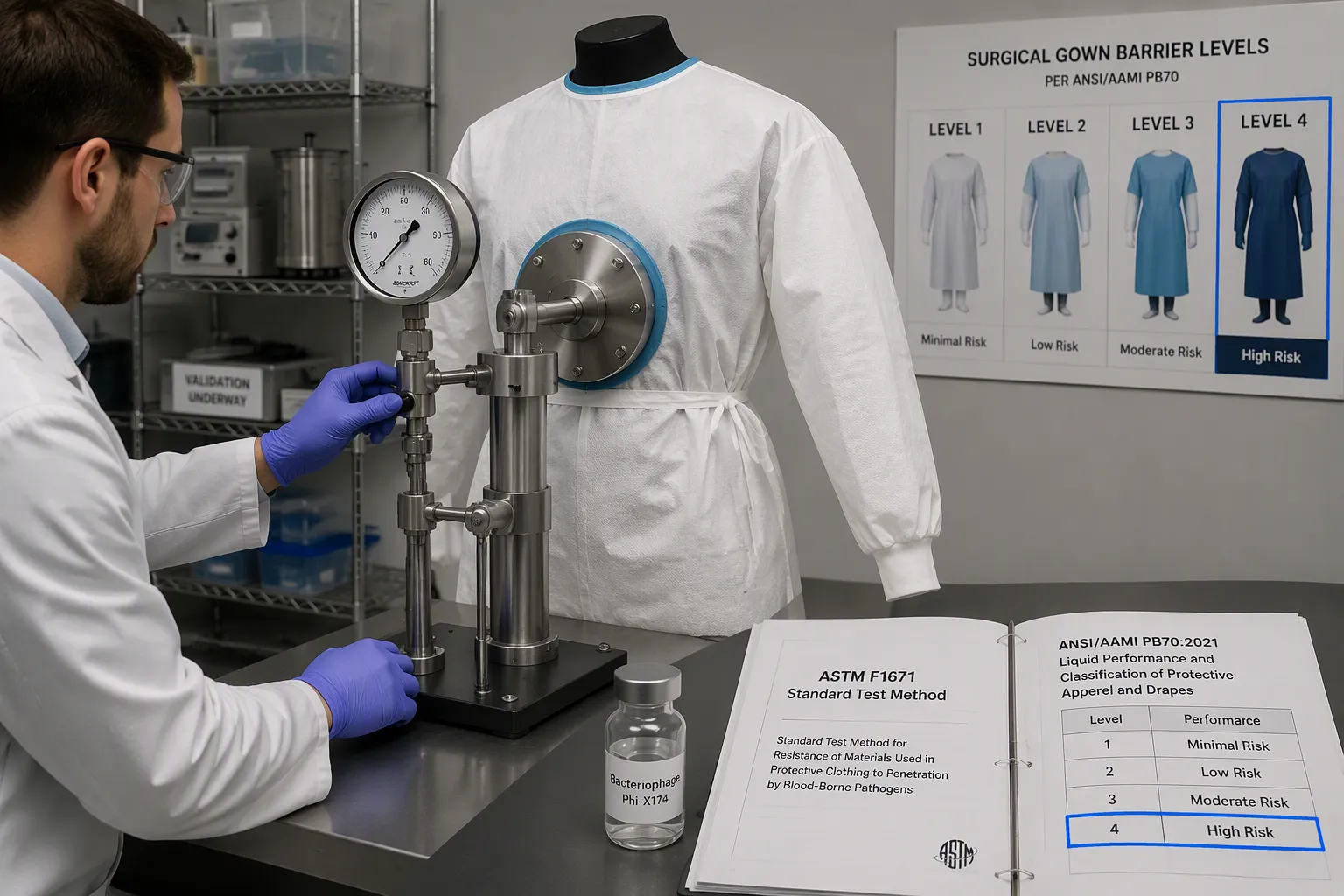
Before you audit a supplier, learn the core standards. AAMI Level 4 surgical gowns must pass ASTM F1671 in critical zones. This requirement separates them from lower levels. These standards define your audit criteria. ANSI/AAMI PB70 serves as the baseline classification system. It defines four levels of barrier performance for medical grade apparel. The four levels offer an AAMI level 1–4 protection scale. Only Level 4 provides a viral barrier. You buy these gowns for high-risk procedures with significant fluid exposure. All isolation gowns must meet AAMI PB70 standards for their claimed level. You purchase PPE through a careful selection process. Surgical settings demand the highest barrier performance.
Key Performance Standards: ASTM F1671 and ANSI/AAMI PB70
ASTM F1670 and F1671 fluid and viral penetration tests in critical zones
ASTM F1671 is the viral penetration test. It distinguishes Level 4 protection from lower levels. Manufacturers test only Level 4 products for viral penetration resistance. This standard considers these products impermeable. Manufacturers test Levels 1–3 only with water using AATCC 42 and AATCC 127 methods. Water has higher surface tension than blood. No correlation exists between those tests and ASTM F1671 results. You cannot consider Levels 1–3 impermeable to blood or viral penetration.
The table below shows the key performance requirements:
Performance Requirement | Specification |
|---|---|
Challenge agent | Bacteriophage Phi-X174 |
Pressure condition | No penetration at 2 psi (13.8 kPa) |
Exposure duration | 1 hour total, with the 6th minute held at 13.8 kPa (2 psi) for one minute |
Applicability | Only AAMI Level 4 products are tested for viral penetration resistance; Levels 1–3 are not considered impermeable |
Basis for test conditions | Derived from ASTM F903 (liquid chemical penetration) and correlated with the human-factors “elbow lean” strikethrough test |
These specifications set the benchmark for your audit.
Minimum barrier performance requirements for high-risk settings
ANSI/AAMI PB70 establishes the classification system for protective apparel in healthcare facilities. The standard defines four levels using standardized test methods.
Liquid barrier performance and classification of protective apparel and drapes intended for use in health care facilities
Level 1 provides the lowest protection. Level 4 provides the highest. Only Level 4 gowns provide impermeable barrier protection. You need these items for high-risk procedures.
Classification Level | Protection Ranking |
|---|---|
Level 1 | Lowest level of protection |
Level 2 | Higher than Level 1 |
Level 3 | Higher than Level 2 |
Level 4 | Highest level of protection |
When you audit, verify that the supplier’s items meet these AAMI PB70 requirements. You source multiple isolation gowns for different clinical applications.
Material Specifications for Medical Grade Apparel
Virgin SMS polypropylene, film-laminated composites, and CPE materials
Verify the raw materials. Medical grade apparel for Level 4 uses SMS polypropylene. Some suppliers use film-laminated composites. Others use CPE materials. Check that the supplier uses virgin materials. Recycled materials compromise barrier performance. Your audit should include a review of material certifications. Check supplier qualification records for all isolation gowns you purchase. These isolation gowns require strict quality control from raw material to finished product. When you buy fluid-resistant isolation gowns, confirm the material composition matches your specifications.
Construction types and seam sealing methods for fluid resistance
Construction matters as much as material. Inspect seam performance during your audit. Seam gapping allows fluid penetration. Cuff stitching must stay secure. Asymmetrical sleeve construction requires careful inspection. Adhesive bonding and tape placement on seams must meet specifications. Give extra attention to seam sealing for all disposable isolation gowns you source. These disposable products must hold up under pressure. These details determine whether a product passes ASTM F1671. Confirm the supplier has validated their seam sealing processes.
Regulatory Certifications and Compliance
FDA 510(k) clearance and ANSI/AAMI PB70 certification
Confirm the supplier holds the right certifications. All surgical gowns with AAMI Level 4 classification must hold FDA clearance as Class II medical devices. This requires premarket notification and special controls. The supplier must also hold ANSI/AAMI PB70 Level 4 certification for their claims. These products require strict adherence to regulatory requirements. Without these certifications, you cannot trust the labeling.
When you audit, request copies of these certifications. Verify the FDA Establishment Registration and Device Listing status. Check that the products passed ASTM F1670 and ASTM F1671 under both impact and pressure conditions. Confirm these certifications cover all disposable medical gowns in your procurement plan.
ISO 13485 quality management system and international conformity
ISO 13485 certification shows a strong quality management system. This standard is essential for medical device manufacturers. The table below outlines key requirements:
ISO 13485 QMS Requirement Area | Key Requirements for Medical Device Manufacturers |
|---|---|
Design & Development | Conduct a final design and development review; assess changes for impact on form, fit, function, and safety; review, verify, validate, and approve changes before implementation; maintain a design history file (DHF) throughout product realization. |
Purchasing | Establish purchasing processes ensuring materials meet specifications; define risk-based supplier evaluation; maintain supplier agreements; verify purchased goods; maintain an Approved Supplier List (ASL) and supplier files; conduct on-site audits. |
Production & Service Provision | Plan, execute, monitor, and control manufacturing; use risk-based production controls; define product release criteria; maintain production records with traceability; ensure cleanliness, installation, servicing, and sterilization requirements are defined and validated. |
Identification & Traceability | Identify finished devices by serial, lot, or batch number; segregate non-conforming products; apply UDI where required; maintain distribution records when traceability is required. |
Monitoring & Measuring Equipment | Calibrate or verify all monitoring and measuring equipment; label with ID, calibration status, and due date; maintain calibration records; validate software used in monitoring. |
Measurement, Analysis & Improvement | Measure against product specifications; analyze trends; drive improvements using the Plan-Do-Study-Act cycle; incorporate customer feedback and complaint handling. |
Certification & Regulatory Context | ISO 13485:2016 is the current version; certification is expected by many regulators and customers; FDA’s QMSR incorporates ISO 13485:2016 into 21 CFR Part 820; ISO 14971 risk management outputs connect to QMS processes. |
You need this certification from your supplier. It demonstrates quality and safety commitment. It aligns with FDA QMSR requirements. This certification supports market access for your disposable PPE gowns and other apparel. All disposable products need this level of quality assurance.
Preparing for the Supplier Audit
A good audit begins before you enter the factory. You need a clear plan, the right papers, and a skilled team. This readying step builds the base for all later steps.
Defining Audit Scope and Requirements
Product volume, lead time, and SKU complexity for bulk procurement
Your audit scope must match what you actually buy. Start by writing down your expected order size. A supplier that makes small batches may fail with large orders. Ask about their lead times for big orders. Check that they can meet your delivery schedule without taking shortcuts.
SKU complexity matters too. If you need many sizes, colors, and packaging types, see if the supplier can handle that mix. Complex orders raise the chance of mistakes. Your audit should look at how they track and separate different product lines.
Risk-based audit focus on quality, regulatory, or supply chain
Not every supplier has the same risk. A new manufacturer with no record needs more checking than an old one. Decide where to aim your audit based on your biggest worries. If rules are very important, spend more time on certification records. If supply chain problems worry you, look into their raw material sources.
This risk-based method saves time and aims your effort. You look at the spots most likely to cause trouble. Write down your focus areas before the audit starts.
Pre-Audit Document Requests
Technical files, design history records, and sterilization validation reports
Ask for key papers before your visit. Ask for technical files that describe product details. Design history records show how the product grew from idea to final version. Sterilization validation reports prove their steps meet needed rules.
Look over these papers ahead of time. Note any gaps or problems. Bring your questions to the on-site audit. This prep makes your visit more useful.
Supplier quality agreements and prior non-conformance logs
Ask for their quality agreement template. This paper spells out duties between you and the supplier. Look at any past non-conformance logs. These records show how they handled earlier problems. A supplier with many unsolved issues is a real risk.
Assembling the Audit Team
Roles for quality engineer, regulatory specialist, and supply chain manager
Build a team with different skills. A quality engineer checks factory controls and testing methods. A regulatory specialist looks at certifications and rule files. A supply chain manager checks capacity and material sources.
Each role gives a different view. Together, they cover all key areas. Define each person’s job before the audit.
Coordinating team responsibilities and pre-audit briefing
Hold a briefing before the audit. Share what you found in the papers with your team. Give each member specific areas to check. Set clear goals for what you need to learn.
This team work stops overlap and makes sure every area gets checked. Your team goes into the audit ready and focused.
AAMI Level 4 Gown Supplier Audit Checklist for Buyers
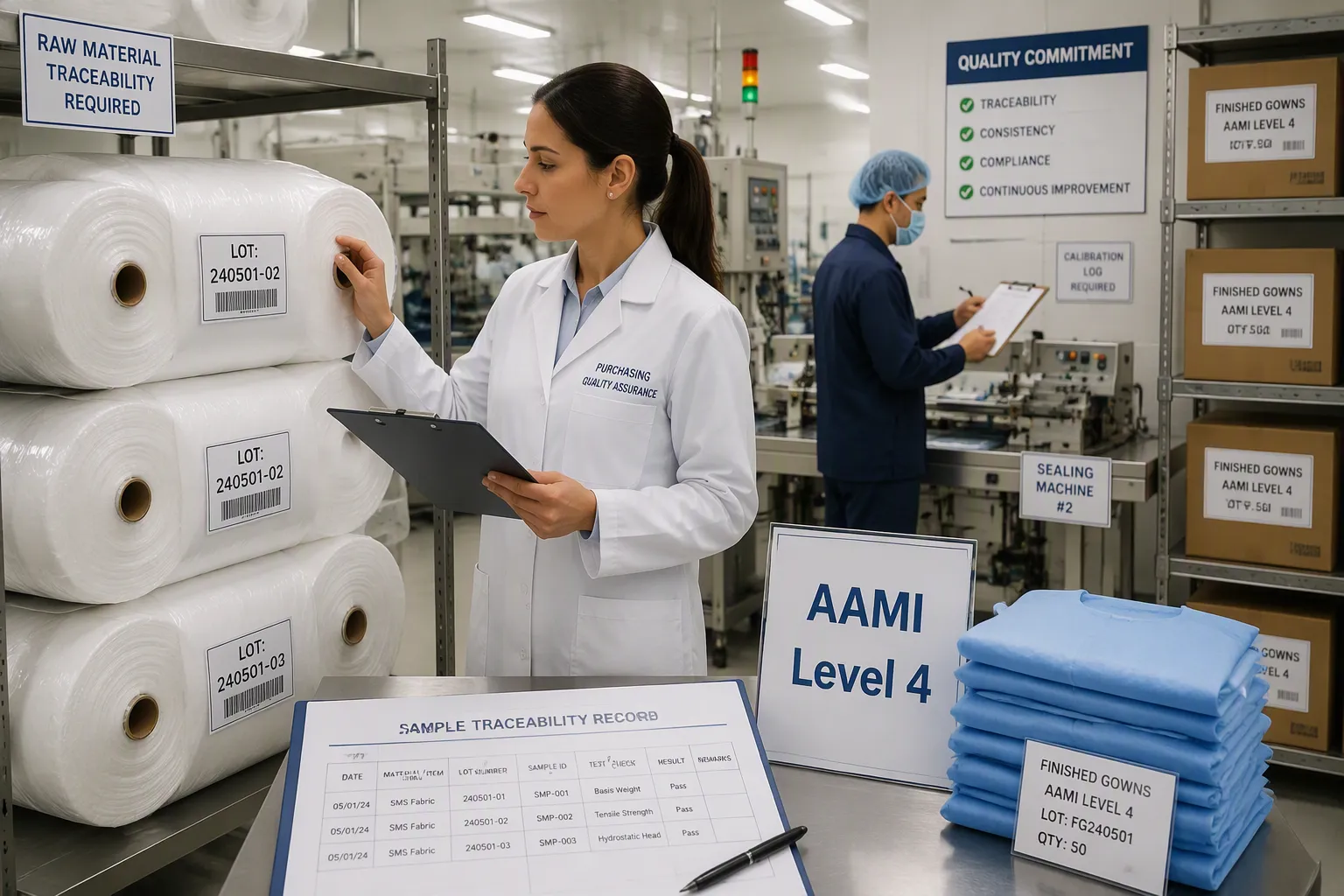
This section provides the main checklist for your factory visit. Use it to check raw materials, watch production, and look over finished product tests. Every item helps you make sure the supplier follows AAMI PB70 standards for each order.
Raw Material Receiving and Storage
Vendor qualification for resin, fabric, and film suppliers
Begin at the receiving area. Ask for the approved supplier list for resin, fabric, and film vendors. A good supplier approves each vendor using a risk-based method. They store supplier files with test data and audit records. Verify that the fabric vendor supplies virgin SMS polypropylene or film-laminated composites. Request material certificates that match your needs. If the supplier cannot show vendor qualification records, see this as a red flag. Poor raw material control puts all your orders at risk.
Inventory traceability and lot segregation for medical grade apparel
Walk through the storage area. See how they label and separate lots. Medical grade apparel needs full traceability from raw material to finished goods. Each fabric roll should have a lot number. Each box of finished gowns should connect to that number. Make sure they keep bad materials in a locked or clearly marked area. Mixing good and bad stock is a big risk. Ask them to show a sample traceability record. Follow one lot from receiving, through production, to final packing.
Manufacturing Process Controls
Converting and sealing machine calibration and maintenance logs
Go to the production floor. Ask for calibration records on all converting and sealing machines. These machines join seams and apply tape. A machine that is out of calibration makes weak seals. Check the maintenance log for each machine. Look for a regular schedule and signed dates. Missing or expired calibration certificates show a quality system problem. This problem hurts the barrier performance of your disposable PPE gowns.
In-process inspection for seam gapping, adhesive bonding, and tape placement
Watch workers do in-process checks. They should check seams at set times. Look for seam separation, weak glue, and tape that is not straight. Focus on cuff stitching and sleeves that are not symmetrical. These parts get the most fluid during surgery. Ask the line supervisor how they note defects. A good system records defects by type and station. That data helps fix problems fast before many bad items appear.
Finished Product Testing and Lot Release
AQL sampling for visual inspection, dimensional checks, and pinhole integrity
Look at the finished product testing plan. The supplier should use AQL sampling for visual check, size check, and pinhole check. Ask for the sampling plan and the pass/fail rules. Make sure testers check every size and style in the lot. Review their defect sorting system. Big defects like pinholes must cause the whole lot to fail. Small defects may pass within the AQL limit. Confirm that trained inspectors do these checks, not regular line workers.
In-house fluid resistance testing or certified third-party lab reports
This step is very important for AAMI Level 4 proof. The supplier must show test reports for ASTM F1670 and ASTM F1671. ASTM F1670 checks synthetic blood leak at 2 psi for 1 hour, requiring no leak. ASTM F1671 checks virus leak using Phi-X174 virus, also requiring no leak. The table below lists the main test methods and papers you must check.
Category | Requirement | Details |
|---|---|---|
Test Methods | AATCC 42 | Water impact penetration test (all AAMI levels). |
Test Methods | AATCC 127 | Hydrostatic pressure test; for Level 4 must be at least 80 cm H₂O. |
Test Methods | ASTM F1670 | Synthetic blood penetration test (Level 4 only). |
Test Methods | ASTM F1671 | Viral penetration test (Level 4 only). |
Documentation | Test Reports | Accredited lab reports showing specific test results, not just pass or fail. |
Documentation | Quality System | ISO 13485:2016 certificate (still valid) for medical device quality management. |
Documentation | Regulatory | CE certificate under EU MDR for EU imports and FDA 510(k) registration for US imports. |
Lot Release | Per-batch COC | Certificate of Conformity for each shipment, listing AAMI level, lot number, and test standards. |
Lot Release | Lot Traceability | Packing list with lot numbers and test reports from the batch, not just sample certificates. |
Lot Release | Sterilization | If sterile product required, include EO or Gamma sterilization validation documents. |
Ask for test papers that are for the exact product. General material certificates do not prove a finished gown passes ASTM F1671. Each gown design needs its own test report. Check that reports have the product ID, test date, report number, and a clear pass or fail result. Use this checklist to check AAMI levels for every order of disposable medical gowns. This keeps your hospital gown supply and your patients safe.
Documentation and Certification Review
Paperwork shows things you cannot see on a factory tour. You need to check regulatory files, quality records, and labeling data before you trust any supplier.
Regulatory and Compliance Files
FDA Establishment Registration and Device Listing status
Request the FDA Establishment Registration and Device Listing for each factory that makes your gowns. These records show that the supplier can legally make surgical and isolation gowns for the US market. Check the premarket notification file for each product. The FDA guide about 510(k) submissions for surgical gowns and drapes lists what you need to include. Look at biocompatibility data for surface devices with short contact. The FDA suggests testing for cytotoxicity, sensitization, and irritation using ISO standards. For sterile isolation gowns, check the sterility assurance level of 10⁻⁶. Verify the sterilization method, packaging details, and EtO residue limits.
CE marking or other international conformity assessments for gowns
For EU imports, ask for the CE certificate under EU MDR. This certificate proves the product meets European rules for medical clothing. Other markets need their own papers. Request the full set: product details, material details, test reports, quality certificates, regulatory papers, disinfection records, packaging details, labeling info, sample approval records, and inspection needs. The exact list depends on where you sell the product.
Quality System Records
Internal audit logs, corrective actions, and supplier scorecards
Check the internal audit schedule and the newest reports. Look for issues still open and how quickly the supplier fixed them. Review corrective action records for repeated problems. A good supplier tracks each fix with a cause and a deadline. Ask for scorecards on fabric and film vendors. These cards show how the factory grades its partners on quality and delivery.
Process validation (IQ/OQ/PQ) for critical manufacturing steps
Ask for process validation records for sealing, bonding, and sterilization. Installation, operation, and performance qualification show the equipment works correctly. Without these records, you cannot trust seam strength across all production runs.
Labeling and Packaging Verification
Label accuracy for sizing, lot number, and sterile barrier expiration
Take random samples from finished goods. Check the label for size, lot number, and expiration date. The lot number must match the traceability record. The expiration date must match the sterile barrier data. Any mismatch shows poor process control.
Packaging integrity testing for sterile barrier systems
Request packaging seal strength and integrity test results. These tests confirm the sterile barrier stays intact during shipping and storage. Compare the packaging specification to the test data. A broken seal makes a sterile isolation gown useless.
Red Flags in Supplier Evaluation
You now know what a strong supplier looks like. This section shows you the warning signs that should stop a deal. Spot these problems early and you avoid costly recalls, failed audits, and patient risk.
Material and Test Discrepancies
Using recycled or unvalidated blended materials in medical grade apparel
Some factories cut costs by mixing recycled resin into virgin SMS or film layers. This weakens the barrier. A gown may look fine outside but still fail ASTM F1671. Ask for resin certificates and compare them to the approved supplier list. Walk the receiving area and check roll labels against the bill of materials. If the paperwork does not match the physical stock, treat that gap as a serious warning.
Passing penetration tests with unrepresentative sample sizes
A test report means little when the lab tested a tiny or hand-picked sample. Look at the sample size, the test date, and the product ID on each report. The report must cover the exact gown design you plan to buy. A passing result from a different fabric weight or seam type does not transfer. Ask for per-lot test data, not one old certificate reused across years.
Quality System Gaps
Missing or expired calibration certificates for test equipment
Sealing machines and pressure test rigs drift over time. Without current calibration, every result they produce is suspect. Request the calibration log for each critical machine. Check the certificate ID, the calibration date, and the due date. An expired certificate on a sealing machine means you cannot trust seam strength data for any disposable gown in that run.
High repeat non-conformances without root cause analysis
Review the corrective action log. A healthy system shows few repeats and a clear cause for each fix. A red flag appears when the same defect returns across lots with no documented root cause. That pattern shows the factory patches symptoms instead of fixing the process. Ask how they verify each fix actually worked.
Supply Chain and Capacity Risks
Single-source dependency for key raw materials like SMS or film
Ask how many approved vendors supply the SMS fabric and the film layer. One source creates a single point of failure. A fire, a strike, or a quality hold at that plant stops your entire line. A strong supplier keeps multiple qualified sources and can show you their audit records.
Overstated production capacity without throughput validation
Some suppliers claim huge monthly output to win your contract. Ask for throughput data from real production runs. Check machine count, line speed, and shift patterns against their claim. If they cannot show validated capacity, your order may slip or get rushed. Rushed lines skip checks, and skipped checks raise defect rates on your disposable isolation gowns.
Watch for these red flags across every audit. They protect your certifications, your disposable apparel supply, and your patients.
Post-Audit Evaluation and Supplier Monitoring
Your audit ends when you leave the factory. The real work begins when you score the results and set up a plan to keep watching. This step turns one visit into a long-term system for your disposable gown supply.
Scoring and Supplier Qualification Matrix
Weighting criteria for compliance, quality, cost, and delivery
Build a scoring sheet before you compare suppliers. Give each item a weight based on how much it matters to your hospital or brand. Quality and compliance get the most weight, often 20–30%. Delivery and financial health come next at 15–25%. One example uses quality at 30%, delivery at 25%, compliance at 20%, financial health at 15%, and new ideas at 10%. The chart below shows this split.
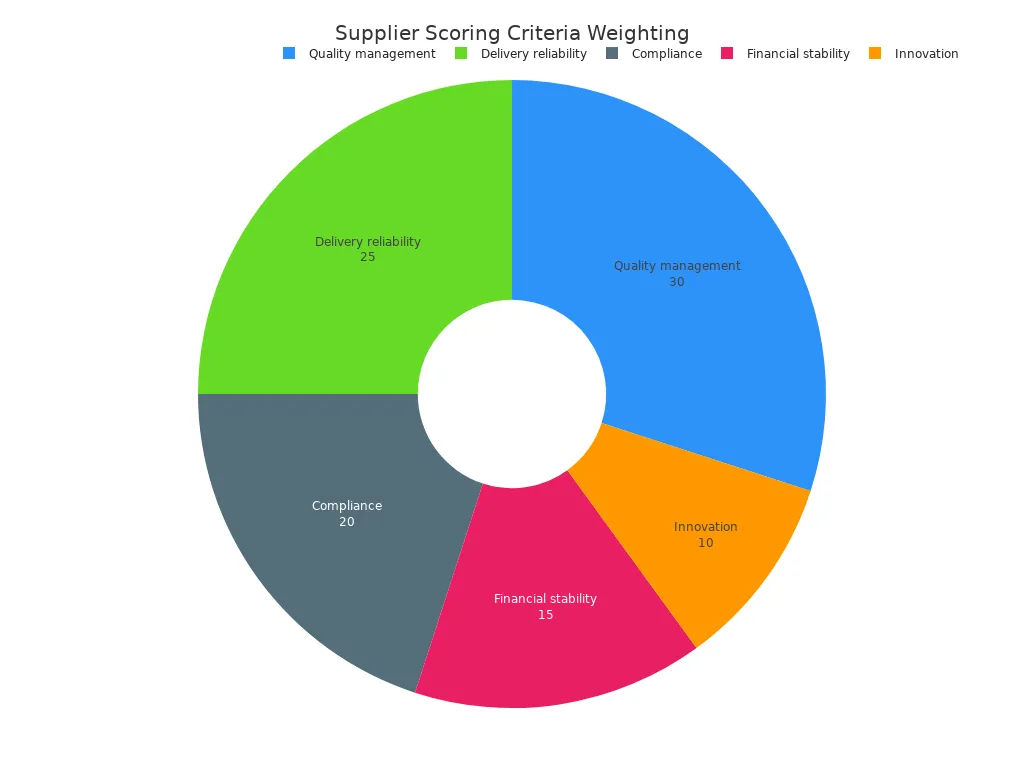
Check these weights often. Your risk changes as your product mix changes.
Setting pass/fail thresholds and escalation procedures
Set a minimum score, usually 70–80 points out of 100. Your industry and how much risk you can take decide the exact number. Suppliers below the threshold need help or replacement. Sort each finding as critical, major, or minor. Give every finding a fix date. Your final call is approved, conditionally approved, or not approved. Conditional approval means a test period with more checks. Critical issues that are not fixed trigger a stop.
QA manager shows me their supplier audit report. 95% score. Approved supplier. Signed by QA head. “When did you do this audit?” I asked. “After purchasing signed the contract,” she said. Here’s the truth about supplier audits: You’re not checking suppliers. You’re backing up buying choices. … Fail the audit → Purchasing blames you for lost business. Pass the audit → You own the quality problems. … When was the last time your audit actually stopped a supplier from being approved?
Implementing Ongoing Surveillance
Annual or biannual scheduled audits and unannounced visits
Plan a full audit every year or two, based on risk. Add surprise visits for high-risk or conditionally approved suppliers. Track vendor performance with digital boards for live updates. Hold quarterly review meetings and feedback talks. Keep open communication so problems come up early.
Quarterly KPIs for defect rates, on-time delivery, and barrier test performance
Set clear KPIs and check them against goals. Watch defect rates, on-time delivery, and barrier test results for every lot of isolation gowns. Track customer complaints to catch issues early. Fix quality problems quickly and take steps to prevent them. Keep records of checks, performance reports, and action plans. This discipline protects your isolation gowns, your disposable PPE, and your patients across every order.
The AAMI Level 4 gown supplier audit checklist for hospital and private-label buyers helps you check ASTM F1671 compliance. You look at material quality. You review how they control the manufacturing process. You confirm how they seal seams and place tape. You keep a structured watch after the audit. Watch for red flags like expired calibration certificates. These gaps point to serious quality system problems. Final steps confirm sterile setup needs. You check packaging and shelf-life details. You confirm size range, fit guidance, and OEM customization options. Get quality control procedures and the certificate of analysis. Using this AAMI Level 4 gown supplier audit checklist for hospital and private-label buyers directly lowers non-compliance risk. It reduces supply chain disruption. It protects your end-users and your procurement investment. Download a printable version of this checklist today. Contact a sourcing consultant to schedule a mock audit before your next high-volume procurement cycle.
FAQ
What makes a gown AAMI Level 4?
A gown gets Level 4 only if it passes ASTM F1671 in key areas. This test for viruses uses bacteriophage Phi-X174 at 2 psi. Lower levels do not take this test. Make sure the supplier has ANSI/AAMI PB70 certification for each gown design you buy.
Which tests must a supplier show you?
Ask for ASTM F1670 and ASTM F1671 reports for the same gown design. ASTM F1670 tests for synthetic blood. ASTM F1671 tests for viruses. Both require no leaks. You also need AATCC 42 and AATCC 127 results because Level 4 needs at least 80 cm H₂O of hydrostatic pressure.
Can a supplier reuse one test report across products?
No. Each gown design must have its own test report. A pass result from a different fabric or seam does not apply to your product. Check each report for product ID, test date, and a clear pass or fail result.
What documents should you request before the audit?
Ask for technical files, design history records, and sterilization validation reports. Also ask for supplier quality agreements and past non-conformance logs. For proof of rules, get FDA 510(k) clearance, FDA Establishment Registration, and ISO 13485 certification. Look over everything before you go to the factory.
What are the biggest red flags during an audit?
Look for recycled or mixed materials in medical grade clothing. Check for expired calibration certificates on sealing machines and test equipment. Look for repeat problems with no root cause analysis. Having only one source for SMS fabric or film also shows real supply chain risk.
How do you verify seam quality on the production floor?
Watch in-process checks for seam gaps, weak glue, and crooked tape. Pay attention to cuff stitching and uneven sleeve designs because these parts see the most fluid. Ask the line supervisor how they note defects by type and station.
How often should you re-audit an approved supplier?
Plan a full audit every year or two, depending on risk. Add surprise visits for high-risk or conditionally approved suppliers. Track quarterly KPIs for defect rates, on-time delivery, and barrier test results. This steady watch catches problems before they reach your patients.
What score should a supplier reach to pass?
Set a minimum score, usually 70 to 80 out of 100. Give quality and compliance the most weight, often 20 to 30% each. Suppliers below the score need improvement plans or a change. Sort findings as critical, major, or minor, and give each finding a fix date.