Is an AAMI Level 4 Gown Always Required for Ebola or MDR-TB Care?
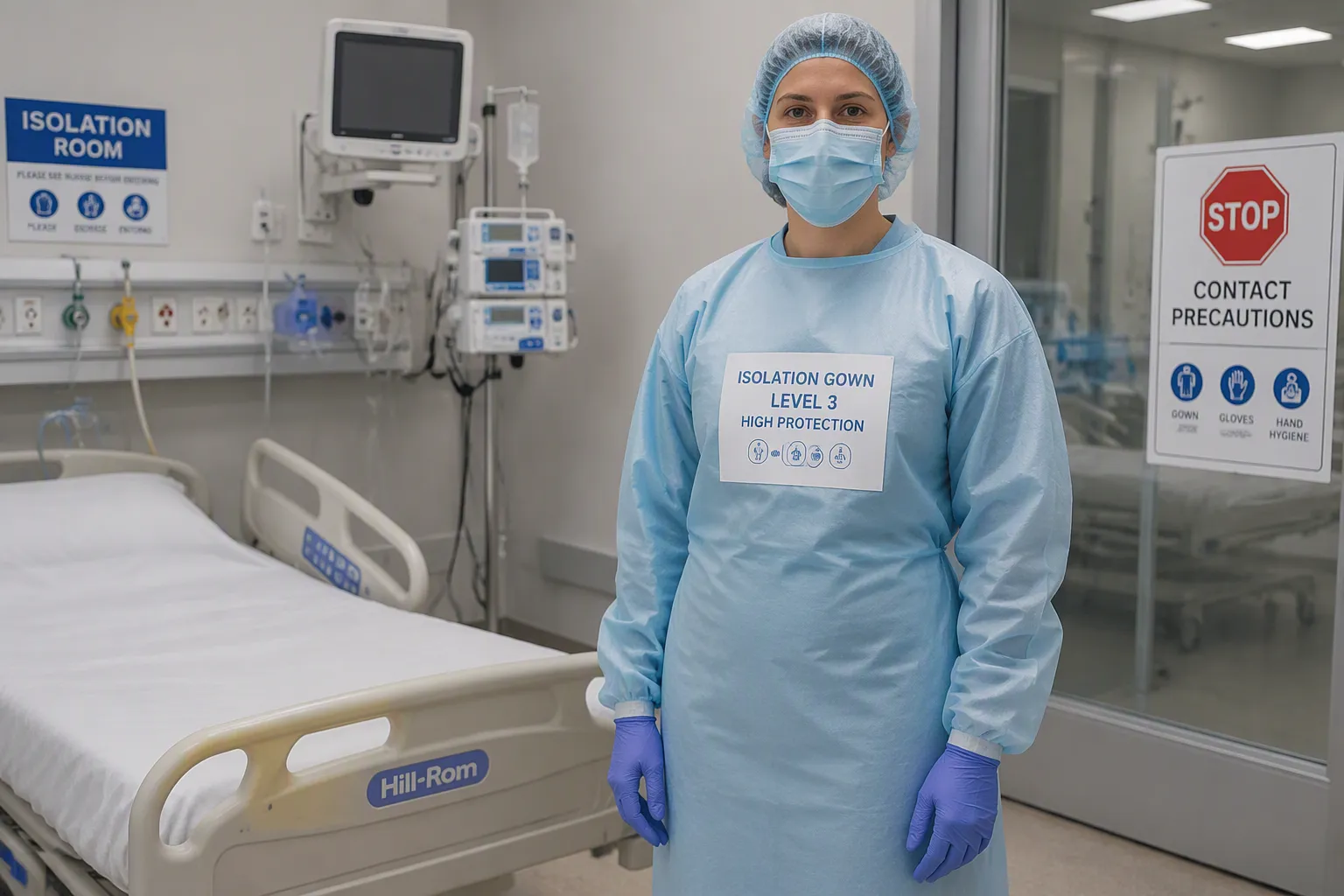
Is an AAMI Level 4 Gown Always Required for Ebola or MDR-TB Care? No. The appropriate level of protection depends on the disease’s transmission route and the likelihood of fluid exposure. Healthcare workers must evaluate each pathogen’s specific risks. For example, Ebola patients often experience significant bleeding, requiring high barrier protection. Standards like ASTM F1671 test gown materials against viral penetration. For MDR-TB, which spreads through airborne droplets, an isolation gown is sufficient. Surgical gown performance varies by AAMI level. These pathogens must also be handled according to official regulations. Always review your facility’s policies. Knowing these distinctions prevents overuse of protective equipment while maintaining safety. Final decisions should follow CDC and WHO guidelines.
Key Takeaways
AAMI Level 4 gowns are not always required for Ebola or MDR-TB care.
The right gown level depends on how the disease spreads and fluid exposure risk.
Ebola spreads through body fluids, so high-barrier gowns like Level 4 are often needed.
MDR-TB spreads through the air, so respiratory protection comes first, not gown level.
Level 2 or 3 gowns work for most MDR-TB tasks, saving supplies and reducing heat stress.
Always check your facility’s policy and do a point-of-care risk assessment.
Over-gowning wastes resources and can cause heat stress, leading to mistakes.
Match the gown to the task, not the pathogen’s reputation, to stay safe and efficient.
The Short Answer on AAMI Level 4 Gowns
No single gown level works for every Ebola or MDR-TB patient. Is an AAMI Level 4 gown always required for Ebola or MDR-TB care? The answer is no. Level 4 protection depends on the situation, not a rule for everyone. Care teams pick a gown based on how a pathogen spreads and how much fluid contact they expect during a task. How severe a disease is does not decide the choice by itself.
Why Level 4 Is Not Automatic
Many people assume the most dangerous pathogens need the highest gown level. That idea does not hold up in real practice. The FDA links gown choice to the fluid exposure risk of a task, not to how severe the organism is. Putting in an IV line calls for a Level 3 gown. A routine blood draw calls for Level 2. Neither task involves Ebola, but both have fluid exposure risk that a lower level may not cover.
Training gaps make this confusion worse. In one survey, 46% of respondents (97 of 211) said they had been trained on the four levels of fluid barrier protectiveness defined by ANSI/AAMI PB70. That means more than half of healthcare workers had no formal training on matching a gown to exposure risk. Without that framework, staff may default to the highest level out of caution or choose no gown at all.
How Transmission Route Changes the Choice
Ebola spreads through direct contact with infected body fluids. That route creates a heavy fluid exposure risk, so high-barrier protective clothing becomes central to the ensemble. MDR-TB spreads through airborne droplet nuclei. A healthcare worker caring for an MDR-TB patient needs respiratory protection first. An isolation gown still matters for contact with secretions, but the fluid volume is much lower.
This difference drives the whole decision. A viral hemorrhagic fever like Ebola pushes facilities toward fluid-impermeable surgical gowns tested against bloodborne viral penetration. An airborne disease like MDR-TB pushes facilities toward N95 respirators, negative-pressure rooms, and standard isolation gowns. The transmission route, not the pathogen’s reputation, sets the protective bar.
What Official Guidelines Say
CDC and WHO guidance reflects this task-based approach. Both bodies direct facilities to match protective clothing to the expected exposure, then follow local policy when it is stricter. The ANSI/AAMI PB70 standard provides the classification framework. ASTM F1670 and ASTM F1671 provide the test methods that separate fluid-resistant gowns from fluid-impermeable ones.
The evidence shows that practice often differs from guidance. One study found that fewer than 25% of respondents had Level 4 gowns available for C. difficile or MRSA care, and 39.3% would choose Level 4 for C. difficile while 16.5% had only Level 1 on hand. The authors concluded that a unified, task-based framework is needed, one that links gown performance to clinical risk rather than pathogen severity. They also stressed that gowns are not impermeable and must be matched to procedural risk.
Regarding isolation gown levels, 46% of respondents (97 of 211) answered “yes” to the question “Have you been trained to understand the four levels of fluid barrier protectiveness gowns may offer, as defined by ANSI/AAMI PB70:2022?
Understanding AAMI Gown Levels
AAMI Levels 1 Through 4 Explained
The ANSI/AAMI PB70 standard sorts protective clothing into four levels. Each level uses specific tests for liquid barrier performance. These standards help healthcare workers choose the right protective clothing. This system helps pick the correct level. Each level has its own test requirements.
Level 1 clothing passes the AATCC 42 impact penetration test. Level 2 surgical gowns pass AATCC 42 and AATCC 127 hydrostatic pressure tests. Level 3 surgical gowns meet higher hydrostatic pressure requirements. Level 4 surgical gowns are tested with ASTM F1670 for synthetic blood penetration and ASTM F1671 for viral penetration. These gowns need premarket notification. Each level gives a certain barrier.
What Level 4 Testing Measures
Only Level 4 surgical gowns go through ASTM F1671 testing for viral penetration. This standard uses the Phi-X174 bacteriophage for blood-borne pathogens. ASTM F1671 applies constant liquid contact at 2 psi. The result is pass or fail for gown barrier performance. Level 4 gowns must also pass ASTM F1670 for blood barrier performance against synthetic blood. Passing both ASTM F1670 and ASTM F1671 ensures a gown is impervious. These items give high barrier protection. Healthcare workers need clothing that passes this test. The viral penetration test uses a bacteriophage. AAMI Level 4 is the highest class.
Fluid-Resistant vs. Fluid-Impermeable Gowns
AAMI Levels 1 through 3 are fluid-resistant clothing. These gowns resist water spray but not blood. Level 4 gowns are fluid-impermeable clothing. Their barrier stops blood from getting through. Healthcare facilities must know this difference. Choosing protective gear depends on blood exposure risk. Isolation gowns usually fit low-risk tasks. Standard isolation gowns work for minimal contact. Surgical gowns at Level 3 or Level 4 fit higher-risk tasks. Level 4 surgical gowns give an impervious barrier. The liquid barrier of each gown drives the choice. For Ebola care, workers need surgical gowns with blood barrier performance. The barrier performance decides the clothing level. The ANSI/AAMI PB70 standard guides this process.
Ebola Care and Protective Gown Needs
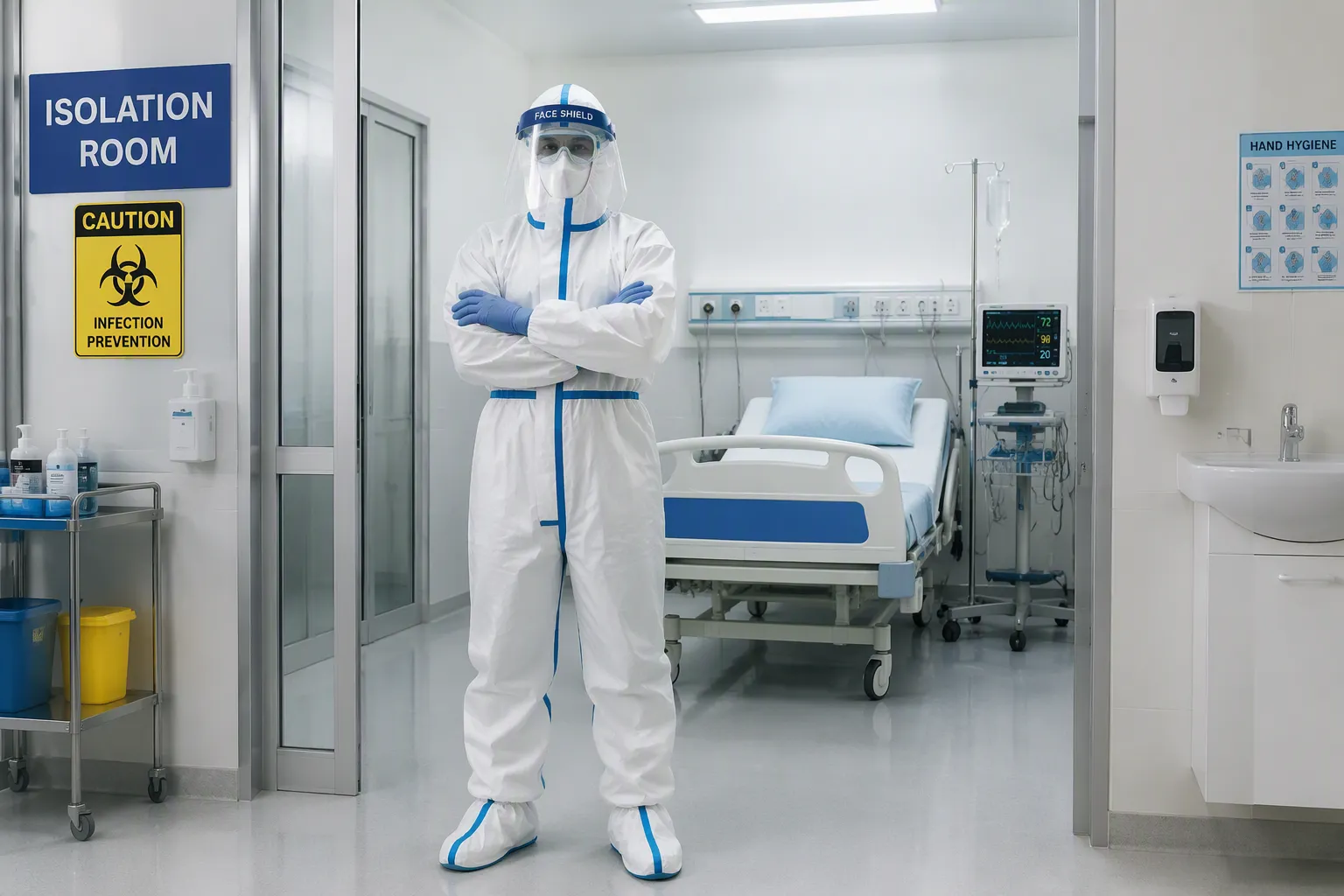
Why Ebola Demands High-Barrier Protection
The Ebola virus acts unlike most germs a hospital sees. It shows up in all body fluids, like blood, diarrhea, vomit, sweat, breast milk, vaginal fluids, and semen. The amount of virus grows very fast during the illness and often peaks at death. Sick patients in later stages get severe diarrhea, vomiting, and bleeding. Each of these symptoms raises the amount of infectious fluid a care team may touch.
That mix creates an unusual risk. High virus levels meet a low amount needed to cause infection. A tiny splash can spread the disease. Limited healthcare in outbreak areas makes this worse, because spread in healthcare settings follows. Protective clothing becomes the last physical shield between a worker and infectious body fluid. Past outbreaks showed that infections among healthcare workers dropped a lot once facilities put barrier steps in place.
The fluid itself drives the choice. A gown or coverall must stop blood and body fluid under pressure, not just repel a light spray. This is why Ebola care pushes facilities toward the top protective performance available. The barrier must hold during heavy contamination, not just during normal contact.
CDC Recommendations for Ebola PPE
CDC and WHO guidance follow this fluid-based logic. Both groups recommend a single-use fluid-resistant gown or coverall. This stops the skin and scrubs below from getting dirty. Virus on skin or clothing can become a way to infect yourself, so the protective clothing must cover the body and reach far enough to block splash from below.
Because there is a high risk of spread through direct patient contact, the CDC and WHO say to use a single-use fluid-resistant gown or coverall to stop contamination of the skin and surgical scrubs underneath. Virus on skin or clothing could be a way to infect yourself.
Notably, the CDC FAQ talks about AAMI PB70 Level 3 and Level 4 gowns only when talking about FDA clearance. It does not say that Level 4 is required for Ebola PPE. The OSHA summary of CDC guidance needs a single-use fluid-resistant or impermeable gown that extends to at least mid-calf, or a coverall without a built-in hood. No AAMI Level 4 rule appears there either. The standard sets the floor at fluid resistance, not at one specific level.
The whole outfit matters as much as the gown. CDC guidance pairs the gown with a trained observer who watches every doffing step and points out breaks. Doffing steps, glove changes, and hand washing are part of the outfit design. They are not gown-level choices. A facility can wear the right gown and still fail if removal contaminates the worker.
When AAMI Level 4 Is Expected
Level 4 becomes the normal expectation when fluid exposure is heavy and long. A patient with a lot of diarrhea, vomiting, and bleeding creates exactly that situation. Under ANSI/AAMI PB70, only Level 4 surgical gowns pass ASTM F1670 for fake blood penetration and ASTM F1671 for virus penetration. ASTM F1671 uses the Phi-X174 bacteriophage at constant liquid contact and 2 psi. A gown that passes both tests gives a barrier that stops bloodborne virus penetration.
Facilities therefore treat Level 4 as the standard for high-fluid Ebola jobs, even though no guideline says it by name. The reason is simple. Levels 1 through 3 resist fluid but do not stop blood under pressure. Level 4 does. When the expected contact involves large amounts of blood or body fluid, that difference decides the choice.
Lower-risk tasks may not need the same barrier. A quick trip to deliver a meal involves far less fluid contact than a bedside procedure on a bleeding patient. Task-based risk check, not just the Ebola diagnosis, sets the level. The trained observer and doffing steps still apply at every level. So does the rest of the outfit. AAMI Level 4 is expected where fluid risk is highest, and the steps around it carry the same weight as the gown itself.
MDR-TB Care and Gown Needs
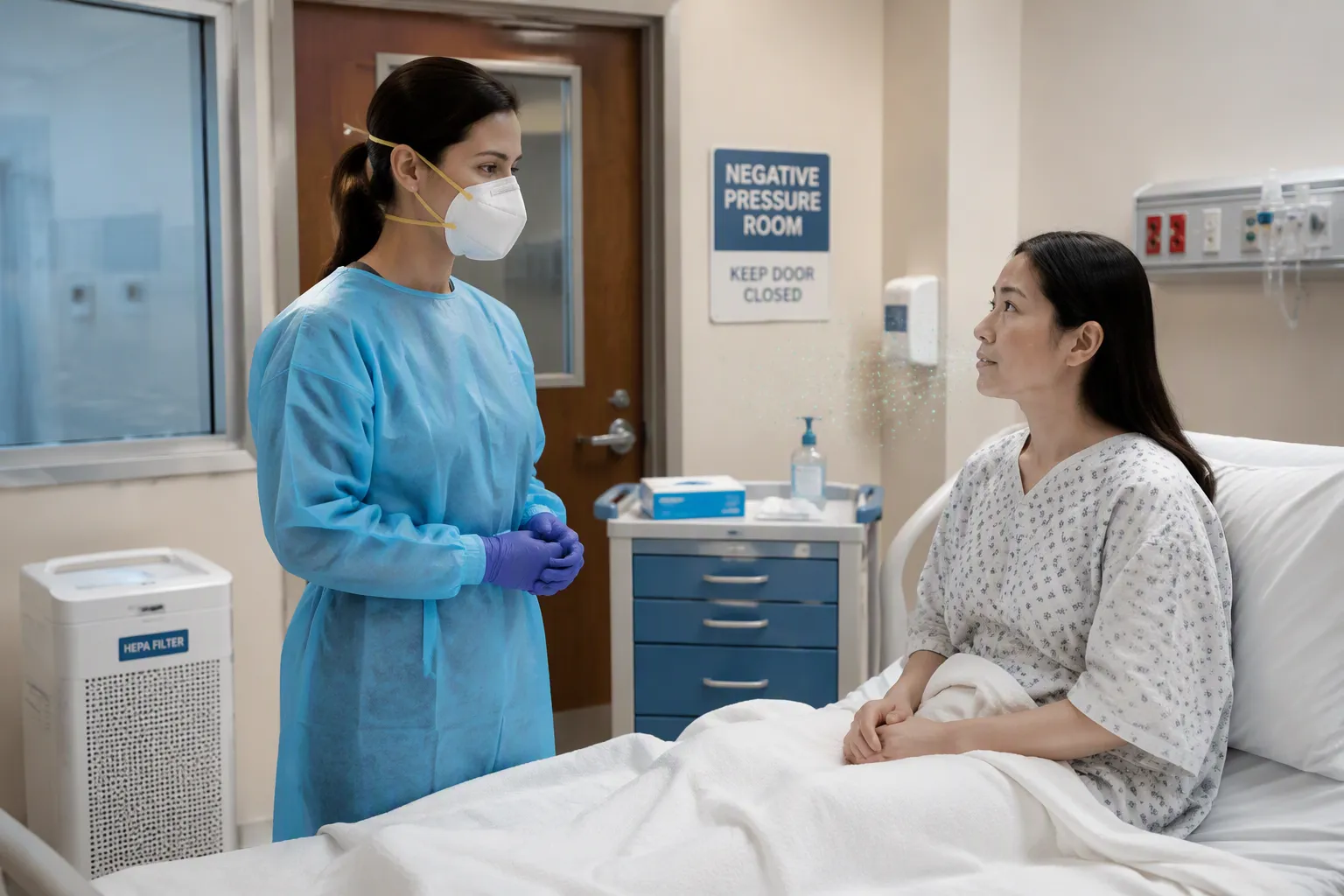
Why MDR-TB Is Airborne, Not Fluid-Driven
MDR-TB spreads through the air. When a patient with active lung disease coughs, speaks, or breathes, they release tiny droplets. These particles float in the air and move around a room. A healthcare worker who breathes them in can get infected. This is completely different from Ebola. Ebola spreads through direct contact with infected body fluids. MDR-TB needs no fluid contact at all.
The PPE rules for drug-resistant TB, including MDR-TB and XDR-TB, are the same as for drug-susceptible TB. MDR-TB and XDR-TB differ by antibiotic resistance, not by how they spread, and they still spread through the air. So the same airborne precautions apply, including AIIR and respiratory protection, and routine gowning is not needed.
This fact surprises many care teams. The germ’s drug resistance makes treatment harder, but it does not change how the germ moves between people. A gown cannot stop an airborne particle. A respirator can. That one difference changes the whole protective outfit for MDR-TB care.
When AAMI Level 2 or 3 Suffices
Routine MDR-TB care rarely needs the highest gown level. AAMI Level 2 or Level 3 protective clothing meets the need for most tasks. These gowns resist fluid spray and block light contamination. They pass the standard tests for impact penetration and hydrostatic pressure. They do not pass ASTM F1670 or ASTM F1671, but those tests target blood and viral penetration. MDR-TB does not spread through blood.
Gowns are not indicated for preventing the transmission of TB. Gowns should be worn to protect the healthcare worker’s skin and clothing if substantial contamination of clothing with potentially infectious respiratory secretions is anticipated (e.g., when performing procedures that could generate respiratory secretions, such as bronchoscopy or endotracheal intubation).
This guidance makes clear what gowns do in TB care. A gown protects against secretions, not against airborne particles. For routine entry into a TB isolation room, a healthcare worker needs a fit-tested N95 respirator or higher, gloves, and eye protection. No gown is required for that task. For entry to perform an aerosol-generating procedure such as bronchoscopy, the worker needs a respirator (N95 or PAPR), an isolation gown preferably with fluid-resistant properties, gloves, and a full face shield or goggles.
The ANSI/AAMI PB70 standard sorts gowns by liquid barrier performance. Level 2 and Level 3 surgical gowns offer fluid resistance that fits secretion-heavy tasks. They cost less than Level 4 gowns and cause less heat stress. Choosing them for MDR-TB care matches the real risk.
Respiratory Protection Comes First
A healthcare worker’s first priority in MDR-TB care is breathing clean air. The gown decision comes second. This order follows the science. Airborne particles enter through the nose and mouth. A gown cannot block them. A respirator can.
N95 Respirators and PAPRs
An N95 respirator filters at least 95 percent of airborne particles when properly fitted. Healthcare workers must complete fit testing before using one. A powered air-purifying respirator, or PAPR, offers a higher level of protection and does not require fit testing. Facilities choose between them based on the task, the worker’s fit test results, and local policy. Both devices protect the airway. Neither replaces the other protective clothing items in the outfit.
Airborne Isolation and Ventilation
An airborne infection isolation room, or AIIR, provides negative pressure and air changes that remove contaminated air. This engineering control lowers the concentration of infectious particles in the room. It works alongside respiratory protection. A healthcare worker who wears an N95 respirator in a properly ventilated AIIR has two layers of defense. A gown adds a third layer only when fluid exposure is expected.
Facilities must maintain these rooms and check their performance. A broken ventilation system weakens every other protective measure. The isolation room and the respirator form the core of MDR-TB protection. The gown plays a supporting role.
Factors That Determine the Right Gown Level
Mode of Transmission
How a germ moves between people is the first thing to check when picking a gown. Contact precautions mean you need a gown and gloves for any interaction that might touch the patient or dirty surfaces. Droplet and airborne precautions call for a mask or respirator, but no gown by default. This difference matters because a gown cannot block a particle floating in the air. It can only stop physical contact with infectious material.
Ebola spreads through direct contact with body fluids, so it falls under contact precautions with high fluid risk. MDR-TB spreads through tiny airborne droplets, so it falls under airborne precautions. The way a disease spreads does not pick the gown level by itself, but it narrows the choices. A care team then looks at the task itself.
Anticipated Fluid Exposure
The amount of blood and body fluid you expect to face drives the final choice. CDC’s point-of-care risk assessment tool asks healthcare workers to think about the type of patient interaction, the chance of contact with blood or body fluids, and the odds that liquid will get through the barrier. A task with large amounts of fluid pushes toward a higher AAMI level. A task with little contact allows a lower one.
The ANSI/AAMI PB70 standard does not require a specific level for any procedure. Facilities match tasks to minimum levels instead. Common practice assigns Level 1 for minimal contact, Level 2 for routine care, Level 3 for higher fluid exposure like trauma, and Level 4 for large fluid amounts or infectious cases. OSHA’s Bloodborne Pathogens Standard at 29 CFR 1910.1030(d)(3)(xi) requires gown selection based on the task and the degree of exposure expected. That rule makes risk assessment a legal duty, not just a suggestion.
CDC, WHO, and Local Alignment
Official guidance from CDC and WHO sets the lowest bar for protective clothing decisions. Local facility policy can raise that bar when its patients or outbreak conditions demand more. A facility treating Ebola patients may require Level 4 surgical gowns even though CDC guidance lists fluid resistance as the minimum. A facility with no viral hemorrhagic fever cases may never stock Level 4 at all.
Healthcare workers should check their own protocol before every high-risk task. The CDC ICAR tool and the APIC Risk Assessment Template give facilities formal ways to measure fluid exposure and match it to the right AAMI level. These tools help care teams avoid two opposite mistakes: under-protecting with a gown that cannot stop blood under pressure, and over-protecting with a Level 4 gown for a task that only needs Level 2. Both mistakes have costs. The first risks infection. The second wastes supplies and adds heat stress.
AAMI Level 4 vs. Lower Levels in Practice
Scenarios That Call for Level 4
Level 4 gowns work best for tasks with a lot of fluid exposure. An Ebola patient with severe diarrhea, vomiting, and bleeding creates this exact problem. The care team expects large amounts of infectious blood and body fluid. Only Level 4 surgical gowns pass ASTM F1670 for synthetic blood penetration and ASTM F1671 for viral penetration. These tests use constant liquid contact at 2 psi. A gown that passes both tests blocks bloodborne viruses from getting through.
Other situations also point to Level 4. A trauma case with heavy bleeding, an orthopedic surgery with major blood loss, or any procedure where the team expects arterial spray all need the highest protection. The ANSI/AAMI PB70 standard does not list these tasks by name. Instead, facilities match the expected fluid amount to the barrier level. When blood exposure is heavy and lasts a long time, Level 4 becomes the practical pick.
Scenarios Where Level 2 or 3 Works
Routine MDR-TB care almost never needs Level 4. A healthcare worker entering an airborne isolation room to check medication needs a fit-tested N95 respirator, gloves, and eye protection. No gown is needed for that task. When a procedure might create respiratory secretions, such as bronchoscopy or endotracheal intubation, the worker needs an isolation gown that resists fluid. A Level 2 or Level 3 gown meets that need.
Level 2 and Level 3 surgical gowns pass AATCC 42 and AATCC 127 tests for impact penetration and hydrostatic pressure. They resist fluid spray and block light contamination. They do not pass ASTM F1670 or ASTM F1671, but those tests target blood and viral penetration. MDR-TB does not spread through blood. Picking Level 2 or 3 for these tasks matches the real risk and avoids needless heat stress.
The Cost of Over-Gowning
Wearing a higher gown level than needed carries real costs. Level 4 gowns cost more per unit than lower-level isolation gowns. They also cause more heat stress for the wearer. A healthcare worker who wears a Level 4 gown for a low-fluid task may tire faster and make mistakes during doffing. That error can spread pathogens to the skin or clothing.
Supply shortages make over-gowning worse. During an outbreak, facilities that use Level 4 gowns for every patient may run out when high-risk cases arrive. The CDC and WHO both stress that protective clothing should match the task. A unified, task-based framework links gown performance to clinical risk. Facilities that follow this approach save supplies and protect workers at the same time. The right level for the right task keeps everyone safer.
Following Local Protocols and Risk Assessment
Why Facility Policy Leads
Facility policy makes the final call on protective clothing. CDC and WHO guidance sets a minimum bar. A local protocol can raise that bar when its patients or outbreak conditions need more. A hospital that treats viral hemorrhagic fever cases may require a higher gown level than a clinic with no such cases. The stricter rule wins.
This rule protects healthcare workers and patients alike. A worker who follows a general guideline instead of a stricter local rule may face a gap in protection. A facility that writes its own protocol based on real risks closes that gap. Local policy also shows supply realities, staff training, and room design. Those factors differ from site to site.
Point-of-Care Risk Assessment
A real-time risk check at the bedside drives the gown decision. The CDC point-of-care risk assessment asks the worker to weigh the type of interaction, the chance of contact with blood or body fluids, and the odds that liquid will pass through the barrier. A task with heavy fluid exposure pushes toward a higher AAMI level. A task with little contact allows a lower one.
The ANSI/AAMI PB70 standard does not name a required level for any procedure. Facilities match tasks to minimum levels instead. OSHA’s Bloodborne Pathogens Standard at 29 CFR 1910.1030(d)(3)(xi) makes this matching a legal duty. A worker who skips the risk check may over-gown or under-gown. Both errors carry costs.
Reviewing PPE Decisions
Regular review keeps protective clothing choices aligned with current evidence. A facility should track which tasks use which gown levels and compare that pattern to its written protocol. The CDC ICAR tool and the APIC Risk Assessment Template give formal ways to measure fluid exposure and match it to the right level. These tools help teams spot drift before it becomes a habit.
Review also catches over-gowning. A worker who wears a Level 4 gown for a low-fluid task wastes supplies and adds heat stress. That stress can lead to mistakes during doffing, which spreads pathogens to skin or clothing. A team that reviews its choices can correct this pattern. The right level for the right task keeps everyone safer.
Is an AAMI Level 4 gown always required for Ebola or MDR-TB care? No. The answer depends on transmission route and fluid exposure risk. Ebola creates heavy fluid contact, so healthcare teams typically choose a Level 4 gown for its viral penetration resistance under ASTM F1671. MDR-TB spreads through the air, so Level 2 or 3 isolation gowns suffice alongside airborne precautions. Local protocols, official guidelines, and real-time risk assessment drive the final choice. Healthcare workers should verify their facility’s policy rather than defaulting to the highest level out of habit. The right gown matches the task, not the pathogen’s reputation.
FAQ
What makes an AAMI Level 4 gown different from lower levels?
Only Level 4 passes ASTM F1671 for viral penetration. It stops blood and body fluid under pressure. Levels 1-3 resist fluid but do not block bloodborne viruses. This difference in performance helps pick the right gown.
Does every Ebola patient task need a Level 4 gown?
No. The task decides the level. High-fluid tasks like handling severe diarrhea or bleeding need Level 4. Lower-risk tasks, like bringing a meal, may only need a fluid-resistant gown.
What is the first protection step for MDR-TB care?
Respiratory protection. An N95 respirator or PAPR blocks airborne particles. An isolation gown is only needed when you expect secretions. The gown is a backup.
How does the CDC help pick the right gown for these pathogens?
CDC says to match the gown to the fluid exposure you expect. For Ebola, use a fluid-resistant or impermeable gown. For MDR-TB, use isolation gowns when you expect secretions. Your local policy may set a higher standard.
Can an isolation gown take the place of a Level 4 gown for Ebola?
No. Isolation gowns at Levels 1-3 resist fluid but do not stop blood under pressure. Level 4 gives the fluid-impermeable barrier needed for heavy exposure. Healthcare workers must match the gown level to the risk.
Why does fluid exposure risk matter more than how severe the pathogen is?
The ANSI/AAMI PB70 standard links gowns to fluid contact, not disease severity. Heavy blood exposure needs higher protection no matter the germ. Healthcare facilities use this task-based method to stay safe.