AAMI Level 3 vs Level 4 Gowns: Tests, Critical Zones and Buying Criteria
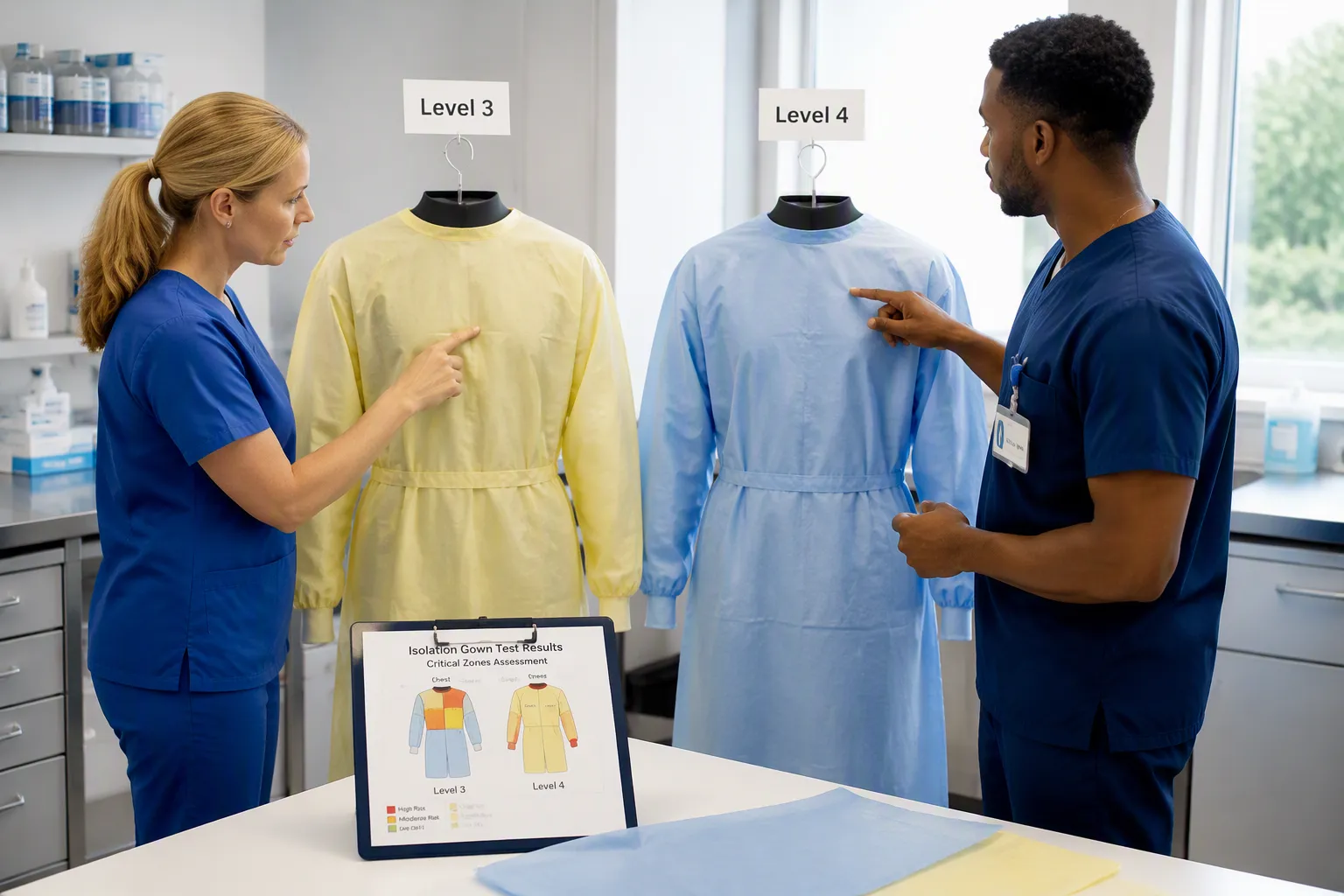
AAMI Level 4 gowns give the highest protection against fluids. They are the only level tested against bloodborne pathogens through ASTM F1671. Level 3 surgical gowns offer moderate-to-high protection for the widest range of surgeries with moderate fluid exposure. Three things drive the choice between AAMI level 3 vs level 4 gowns: tests, critical zones, and clinical risk assessment. Level 3 gowns must pass AATCC 42 with impact ≤ 1.0 g and AATCC 127 with hydrostatic pressure ≥ 50 cm. Level 4 gowns must show no penetration at 2 psi (13.8 kPa). This article breaks down the ANSI/AAMI PB70 standard, ASTM test methods, zone requirements, and buying criteria. Healthcare buyers can then match gown level to setting. These gowns protect workers and help stop infections. This comparison helps control safety risks and meet compliance standards. Reusable protective gowns and isolation gowns follow different rules. Surgical gowns need careful selection for patient and staff safety.
Key Takeaways
Level 4 gowns pass the ASTM F1671 viral penetration test. Level 3 gowns do not pass this test.
Level 3 gowns keep you safe from moderate amounts of fluid. Level 4 gowns protect you from high-risk fluids.
Critical zones include the front panel, sleeves, and sides. Level 4 gowns must pass ASTM F1671 in all critical zones.
Pick the gown level based on the clinical risk assessment and fluid volume.
Level 4 gowns cost more. Use a mix of gown levels to control costs.
Check the AAMI level labels and ask for test reports to prove they meet the rules.
Comfort and fit affect whether people wear them. Have staff try samples before you buy.
Reusable gowns must pass the same ASTM F1671 test after many washes.
Understanding AAMI Levels and Gowns
What ANSI/AAMI PB70 Defines
ANSI/AAMI PB70 is the rule that puts healthcare gowns into four barrier levels. Each level shows how well a gown blocks liquid in lab tests. The rule links every level to a certain test method and pass range. This setup helps buyers compare products in a fair way.
The Four-Level Barrier System
The four AAMI pb70 levels build on each other. Level 1 gowns pass AATCC 42 with water penetration at or below 4.5 grams. Level 2 gowns pass AATCC 42 at or below 1.0 gram and AATCC 127 at or above 20 cm H₂O. Level 3 gowns meet the same spray limit and reach at least 50 cm H₂O on the hydrostatic test. Level 4 gowns must show no penetration under ASTM F1670 or ASTM F1671. Barrier properties go up with each step.
Level | Critical Zone Test | Pass Criteria |
|---|---|---|
Level 1 | AATCC 42 | ≤ 4.5 g spray |
Level 2 | AATCC 42 + AATCC 127 | ≤ 1.0 g spray; ≥ 20 cm H₂O |
Level 3 | AATCC 42 + AATCC 127 | ≤ 1.0 g spray; ≥ 50 cm H₂O |
Level 4 | ASTM F1670 / F1671 | No penetration |
Where Level 3 and Level 4 Sit
Level 3 and Level 4 sit at the top of the scale. Level 3 covers moderate-to-high fluid exposure. Level 4 covers the highest risk. Only Level 4 gowns go through viral penetration testing. That one fact sets the two tiers apart for any high-risk task.
Level 3 Gowns: Moderate Barrier Protection
Level 3 gowns give moderate-to-high fluid barrier protection. They pass both the spray and hydrostatic tests. These gowns fit the widest range of surgical procedures with moderate fluid exposure. They also work for many isolation and patient care tasks.
Intended Clinical Uses
Level 3 gowns fit trauma patient care, intravenous line insertion, and arterial blood draws. These tasks involve moderate fluid risk. Staff can wear Level 3 gowns for routine care where splash volume stays low. The gown balances protection with comfort during longer wear.
Level 4 Gowns: Maximum Barrier Protection
Level 4 gowns give the highest protection. Manufacturers reinforce them in the critical zones. These surgical gowns must pass ASTM F1670 and ASTM F1671. The ASTM F1671 test measures resistance to bloodborne pathogens at 2 psi (13.8 kPa). Results are pass or fail. No penetration means the material holds.
Intended Clinical Uses
Level 4 gowns serve high-risk settings. They fit nonairborne pathogen resistance and surgeries with large fluid irrigation. Trauma care and splash-heavy procedures also call for this level. Only Level 4 gowns are tested for viral penetration resistance. That makes them the only choice for high-risk fluid exposure.
AAMI Level 3 vs Level 4 Gowns: Tests That Matter
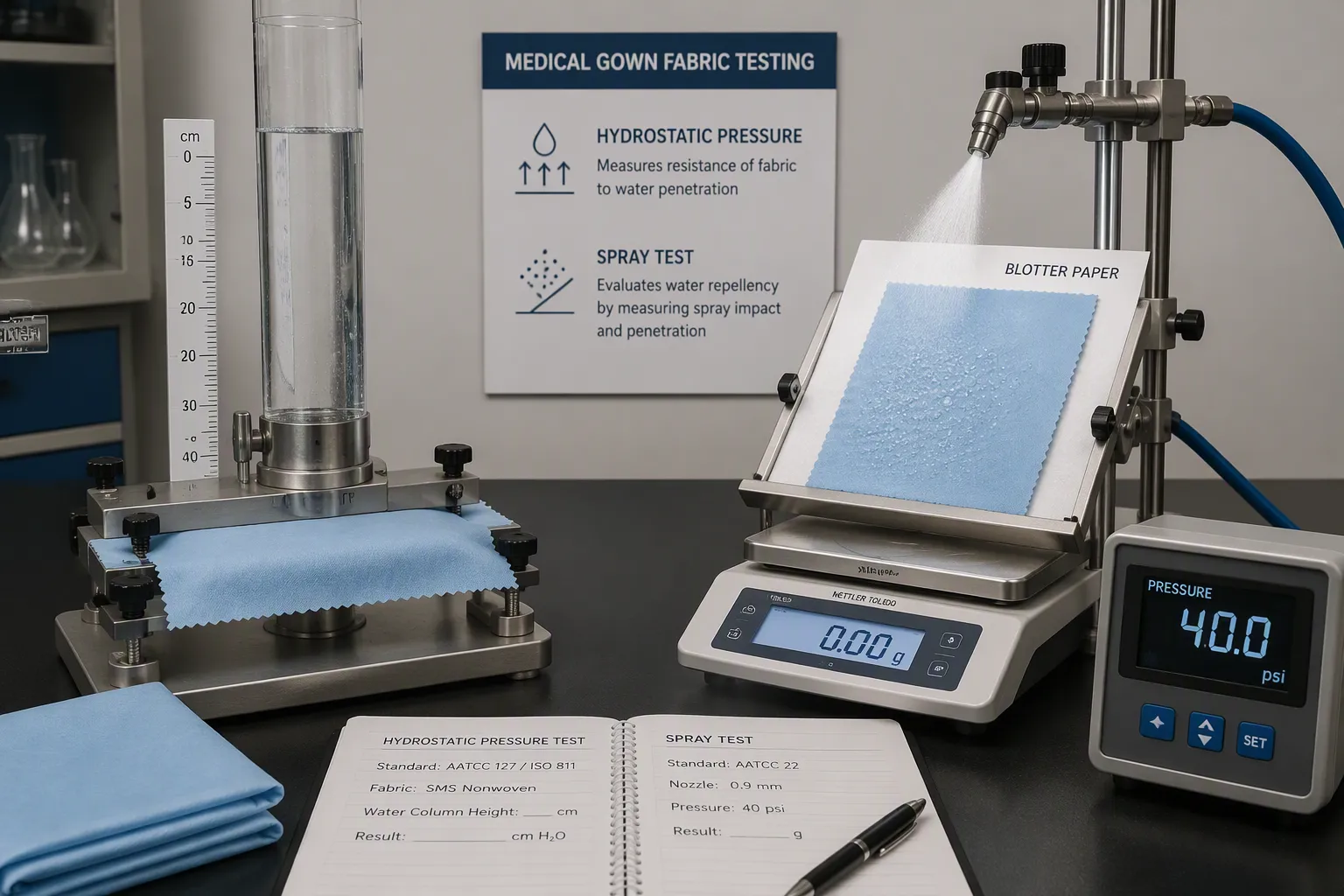
The tests behind AAMI level 3 vs level 4 gowns: tests show the difference between real protection and marketing talk. Each tier has to pass certain lab methods. These methods check how well a gown blocks liquid under pressure, spray, and viral challenge. Buyers who know the tests can read a label with trust.
Hydrostatic Pressure Test
The AATCC 127 test checks how long a column of water takes to push through a material. A sample holds water as the pressure rises. The result shows the height of water in centimeters when penetration happens.
Level 3: One-Second Minimum
Level 3 surgical gowns must reach at least 50 cm H₂O on this test. That bar is higher than Level 2, which needs only 20 cm H₂O. The test runs for a short, set time. A pass means the material holds back a moderate column of liquid without strike-through.
Why Level 4 Exceeds It
Level 4 gowns do not count on the hydrostatic test alone. They must pass ASTM F1670 and ASTM F1671 in the critical zones. These methods push synthetic blood and bacteriophage through the material at 2 psi (13.8 kPa). That pressure is far greater than the hydrostatic column. A Level 4 gown must show no penetration at all.
Impact Penetration Test
The AATCC 42 Impact Penetration Test copies splash and spray exposure. A set volume of water sprays against a tight fabric surface. A pre-weighed blotter sits behind the fabric. After spraying, the blotter is weighed again. The weight gain in grams shows how much water passed through.
Simulating Splash and Spray
This test copies real fluid events in healthcare settings. A surgeon leaning over an irrigation field or a nurse facing a splash risk meets the same physics. The spray hits the gown at an angle. Liquid can wick through pores or seams. The blotter catches every drop that crosses the barrier.
Interpreting Strike-Through Results
A lower blotter weight gain means greater resistance. For Level 3, critical zone parts must show no more than 1.0 gram of water penetration. Level 1 allows up to 4.5 grams. Level 4 does not use this test for its top claim. Instead, it uses ASTM F1670 and ASTM F1671. The table below sums up the difference.
AAMI Level | Impact Penetration Test | Barrier Requirement |
|---|---|---|
Level 3 | AATCC 42 | ≤ 1.0 g water penetration |
Level 4 | Not specified for impact penetration | Impermeable to Phi-X174 Bacteriophage under 13.8 kPa |
ASTM F1670 and ASTM F1671
AAMI standards require a surgical gown to pass ASTM F1670 and ASTM F1671 in the critical zones to earn the AAMI Level 4 label. These two tests form the backbone of high-risk fluid protection.
Synthetic Blood Penetration
ASTM F1670 checks resistance to synthetic blood under ongoing liquid contact. A sample sits in a test cell. One side faces synthetic blood at 13.8 kPa (2 psig). Technicians watch the other surface for any sign of red fluid. Any visual sign of penetration means failure. The result is pass or fail. This method screens materials before the tougher viral test. It applies to nonwovens, films, laminates, and coated fabrics. The synthetic blood mixture uses a red dye and a thickening agent. Its surface tension is set to about 0.042 ± 0.002 N/m.
Bacteriophage Viral Penetration
ASTM F1671 goes further. It uses Phi-X174 bacteriophage as a stand-in microbe. This virus is close in size to HCV and nearly round like HIV and HBV. It is not infectious to humans and easy to find. The test steps follow a strict order. Samples are cut into about 75 mm x 75 mm swatches and conditioned. Each sample loads into a penetration test cell. The reservoir fills with about 60 ml of bacteriophage suspension at a concentration of at least 1.0 x 10^8 plaque-forming units/mL. The suspension sits for 5 minutes at atmospheric pressure. Then an outside air source applies 2 psig for 1 minute. Pressure releases, and the sample sits for another 54 minutes. Technicians then check penetration. No viral penetration means the material passes.
AAMI Level 4 strictly requires passing the ASTM F1671 viral penetration test.
Only Level 4 gowns are tested for viral penetration resistance. That fact makes them the only right choice for high-risk fluid exposure. Level 3 gowns give solid protection for moderate risk. They do not carry the viral barrier claim. Healthcare buyers who face bloodborne pathogen risk must pick Level 4. This choice protects workers and helps control infection. It also meets compliance standards for surgical and isolation settings. Reusable protective gowns and disposable surgical gowns both follow these test rules. The difference lies in the material and the reprocessing method, not the barrier standard. A gown that passes ASTM F1671 in all critical zones gives the highest safety margin. That margin matters most when fluid volume is high and splash risk is real.
Critical Zones in Level 3 vs Level 4 Gowns
The critical zone covers the areas where fluid exposure risk is highest. ANSI/AAMI PB70 defines this zone as at least the front panel and lower sleeves of surgical gowns. The classification of surgical gowns depends on whichever of these two areas performs lower in testing. The entire front of surgical gowns — areas A, B, and C — must meet at least Level 1 barrier performance. The back of surgical gowns may stay non-protective. Buyers must understand these zones to match gowns to clinical risk. This knowledge supports safety and infection control in every setting. Standards for gowns rely on clear zone definitions.
Defining Zones A, B, and C
Zone A: Front and Sleeves
Zone A covers the front panel and sleeves of surgical gowns. Staff lean over patients during procedures. Blood and fluids splash directly onto the front and sleeves. For this reason, Zone A forms the core of critical zone testing for surgical gowns. Both the fabric and the construction — including sleeve seams and front tie attachments — undergo testing to confirm barrier performance. Level 3 requires moderate fluid barrier protection in Zone A using AATCC 42 and AATCC 127 tests. Level 4 requires the highest fluid and microbial barrier protection in Zone A through ASTM F1670 and ASTM F1671 testing. The gown must resist penetration where exposure is greatest. Healthcare personnel depend on this protection.
Zone B: Sides and Back
Zone B includes the sides of surgical gowns. The standard groups the sides with the front for critical zone purposes. The back carries no barrier requirement. Many gowns use non-protective material on the back. This design improves breathability during long procedures. However, the sides of surgical gowns must provide barrier protection equal to the front panel. The gown classification is based on the lower-performing component of areas A and B. Buyers should verify Zone B coverage when selecting surgical gowns for high-risk settings. Healthcare teams rely on this zone for consistent protection.
Zone C: Cuffs and Closures
Zone C covers cuffs, hems, and bindings of surgical gowns. These areas are excluded from critical zone testing at both Level 3 and Level 4. The standard does not require cuffs to pass the same barrier tests as the front panel. However, Level 4 requires all seams on the gown to provide the same level of liquid barrier protection as the rest of the gown. This requirement affects how cuffs attach to sleeves and how closure systems function. The seams of Level 4 gowns must not create weak points where fluid can penetrate. Isolation gowns follow different rules, but healthcare buyers often compare them to surgical gowns. Standards for isolation gowns differ in several ways.
Level 3 Zone Requirements
Which Zones Must Resist Fluid
Level 3 gowns require barrier protection across the whole garment including seams. The critical zone includes the front panel, sleeves, and sides. Cuffs, hems, and bindings stay excluded. The test methods are AATCC 42 and AATCC 127. The impact penetration test allows no more than 1 gram of water weight gain. The hydrostatic pressure test requires at least 50 cm H₂O. Level 3 gowns provide moderate fluid barrier protection. These gowns suit procedures where fluid volume stays low to moderate. These gowns support patient care and infection control in routine settings. Many healthcare facilities use Level 3 gowns as their standard choice. The gown design balances protection with comfort. Isolation gowns share similar design goals for different risk levels.
Level 4 Zone Requirements
ASTM F1671 in All Critical Zones
Level 4 requires the highest barrier protection. The critical zones must pass ASTM F1671 for viral penetration resistance. The synthetic blood test (ASTM F1670) screens materials first. Then ASTM F1671 challenges the gown with Phi-X174 bacteriophage at 2 psi for 1 minute. No visible liquid penetration is allowed. If no visible penetration occurs, a microbial assay confirms the result. No more than 4 percent of gowns may fail. All seams must provide the same barrier level as the rest of the gown. The gown must withstand synthetic blood under 2 psi pressure for 1 minute with zero penetration. The critical zones — defined as the entire gown including seams but excluding cuffs, hems, and bindings — must meet the highest liquid barrier protection level. These requirements make Level 4 gowns suitable for high-risk, high-fluid-volume procedures. They support safety and compliance in demanding surgical settings. Reusable protective gowns and single-use gowns both follow these zone rules. Reusable protective gowns must pass the same ASTM F1671 test after multiple reprocessing cycles. Healthcare facilities verify compliance through routine quality checks.
Healthcare Buying Criteria for Gowns
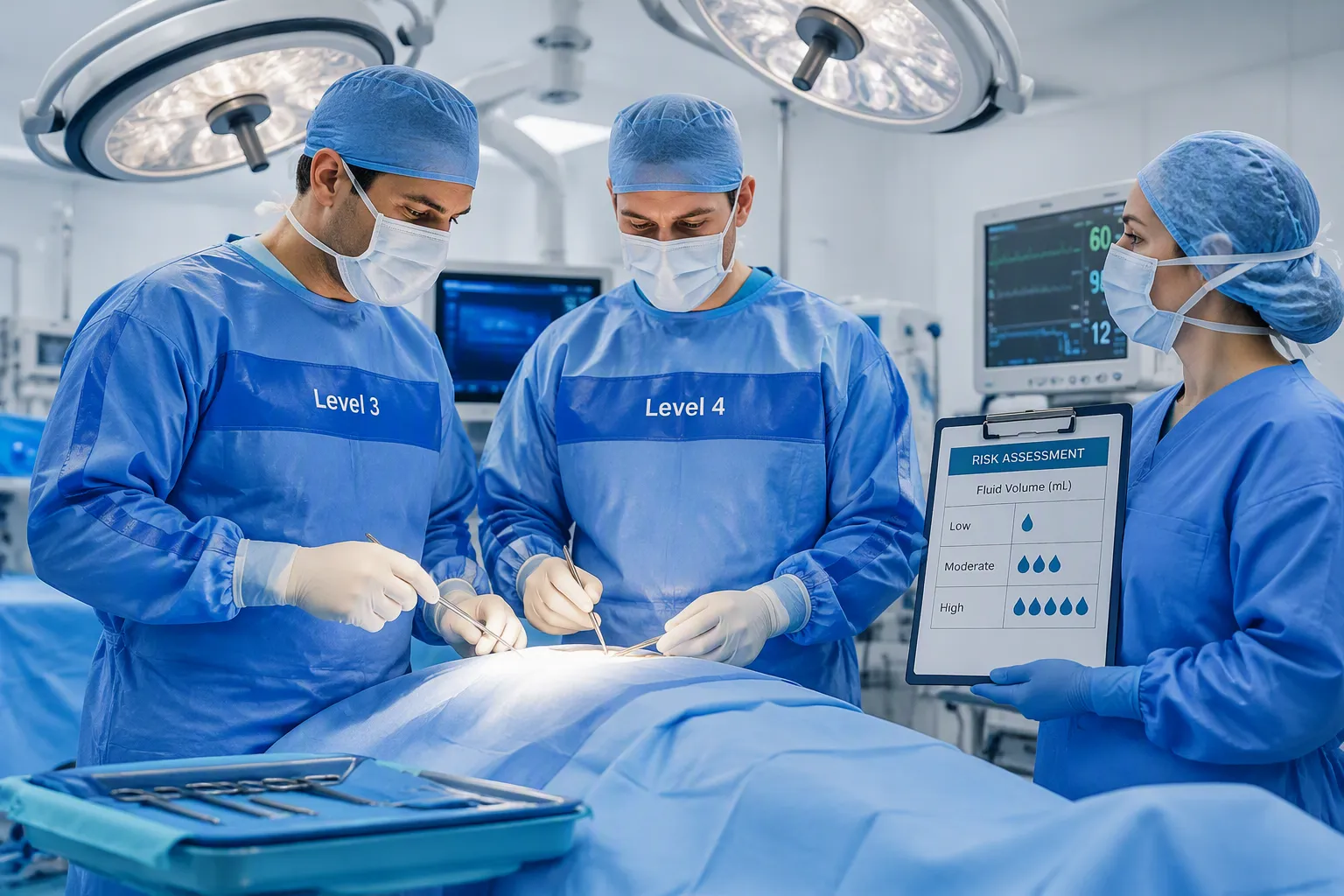
Healthcare buying teams have a clear decision to make. They can choose Level 3 gowns for moderate-risk tasks. They can choose Level 4 gowns for high-risk work with lots of fluid. The right answer comes from a formal risk assessment. It also comes from test data and zone rules. Buyers who match gown level to the setting control costs and protect staff.
Clinical Risk Assessment
Surgical vs Isolation Settings
Surgical settings and isolation settings have different risk profiles. Surgical gowns must follow ANSI/AAMI PB70 rules for the sterile field. Isolation gowns cover a wider range of care tasks. A dental practice needs Level 2 gowns for routine work with water, saliva, and some blood contact. A hospital surgical suite needs Level 2 through Level 4 gowns based on the procedure type. Cardiac surgery and transplant cases call for Level 4 gowns with full-body coverage and high-performance composite fabric. Total joint replacement also needs Level 4 gowns with reinforced barrier zones at the chest and sleeves. Ophthalmic surgery needs only Level 2 gowns with lightweight, breathable fabric. A risk-based approach to gown selection is supported by the difference in barrier performance between the levels.
Matching Level to Fluid Volume
Fluid volume drives the purchasing decision. Level 1 gowns fit basic care and simple excisions with minimal fluid contact risk. Level 2 gowns suit blood draws and suturing with light fluid exposure. Level 3 gowns fit most general surgery, Cesarean sections, and procedures with irrigation or fluid suction. Level 4 gowns fit extended surgeries with heavy blood loss, open trauma, and major cardiovascular procedures. AAMI Level 4 gowns are not required for all surgeries. They are only necessary for high-risk and long-duration surgeries with significant fluid exposure. In many acute-care operating rooms, only 10–25% of annual cases require Level 4 protection. The rest fall at Level 2 or Level 3. Making all cases use Level 4 does not change the clinical risk profile. It only increases the invoice.
Comfort, Fit, and Usability
Breathability and Wear Time
Comfort affects compliance. A gown that feels hot or restrictive may lead staff to remove it early. That action breaks the barrier and raises infection risk. Level 3 gowns balance fluid barrier protection with breathability for longer wear. Level 4 gowns use heavier materials for maximum protection. They may feel warmer during long procedures. Buyers should test samples with staff before choosing one product for everyone. Reusable protective gowns offer another option. They must pass the same ASTM F1671 test after multiple reprocessing cycles. Facilities that use reusable protective gowns should confirm barrier performance stays intact after each wash cycle.
Sizing and Doffing
Size range affects barrier performance. A gown that is too small or too large weakens protection. A gown that gapes at the back or rides up the arms cancels its rated level. Buyers should confirm the offered size range covers the actual staff body-size distribution. Sleeve length and cuff type also matter. Knit cuffs with thumb loops or elastic prevent sleeves from riding up during reaching and bending. Open cuffs are faster to put on but give less consistent coverage. Closure type affects doffing safety. Back-tie closures are cheapest and most common. Hook-and-loop or snap closures speed up putting on and taking off. They also reduce self-contamination risk during removal. This factor matters more as procedure length and AAMI level rise to Level 4. Latex-free options must be readily available under 1910.1030(d)(3)(iii) for employees who need them.
Cost, Compliance, and Verification
Budget Impact of Level 4
Level 4 gowns cost more than Level 3 gowns. Group purchasing organization contract pricing shows Level 3 gowns at $1.20–$2.00 per unit. Level 4 reinforced gowns run $2.00–$4.00 per unit. A mixed-level stocking strategy controls spending. Facilities can target 15–25% of gowns at Level 4, 30–40% at Level 3, and the rest at Level 1–2. They should adjust these percentages based on actual surgical volume and case mix. This approach cuts total gown spend without lowering the protection standard for anyone in the sterile field. Aligning gown level to procedure risk supports infection control in facilities that adopt this approach.
Confirming AAMI Level Claims
Buyers must verify AAMI level labeling before purchase. They should confirm that Level 4 gowns have passed ASTM F1670 and ASTM F1671 in critical zones. The label should state the AAMI level clearly. It should also list the test methods used. Buyers can request test reports from the manufacturer. These reports show pass or fail results for each critical zone. This step supports compliance with safety standards. It also protects healthcare personnel from false claims. AAMI PB70 levels give buyers a common language for comparing products. That language only works when labels tell the truth.
Pick Level 3 gowns for medium-risk jobs with little fluid, like normal patient care or small procedures. Pick Level 4 gowns for high-risk work with lots of fluid or splashes, like surgery or trauma care. The best choice comes from a real risk check, plus ASTM F1670 and ASTM F1671 test results and critical zone rules.
Buyers should check the AAMI level label, make sure the zones are covered, and weigh protection against comfort and cost. Do not just use one level for every setting. This method helps with safety, stopping infections, and following the rules. Healthcare teams can trust surgical gowns that fit the task. Isolation gowns and reusable protective gowns follow the same standards. Picking the right gown protects workers and helps control infections.
FAQ
What is the main difference between AAMI Level 3 and Level 4 gowns?
Level 4 gowns pass ASTM F1671 testing for viral penetration. Level 3 gowns do not. This test uses bacteriophage at 2 psi pressure. Only Level 4 gowns have the bloodborne pathogen barrier claim. Level 3 gowns still give good protection for moderate fluid exposure in many procedures.
Do Level 3 gowns protect against bloodborne pathogens?
Level 3 gowns block fluid using AATCC 42 and AATCC 127 tests. They handle moderate splash and spray. They do not go through viral penetration testing. For bloodborne pathogen risk, buyers must pick Level 4 gowns. That level alone shows resistance to Phi-X174 bacteriophage under pressure.
Which clinical settings need Level 4 gowns?
Level 4 gowns fit high-risk settings with heavy fluid volume. These include open trauma, major heart procedures, and long surgeries with a lot of blood loss. Many acute-care operating rooms need Level 4 protection for only 10–25% of cases each year. The rest work well with Level 2 or Level 3 gowns.
What are the critical zones on a surgical gown?
Critical zones cover the front panel, sleeves, and sides. The back may stay non-protective for breathability. Cuffs, hems, and bindings are not tested. Level 4 gowns must pass ASTM F1671 across all critical zones. All seams must match the barrier level of the rest of the gown.
How do buyers verify AAMI level claims?
Buyers should check the AAMI level label and confirm test methods. For Level 4, they ask for ASTM F1670 and ASTM F1671 reports. These reports show pass or fail results for each critical zone. This step supports safety and keeps staff safe from false claims.
Can facilities use reusable protective gowns at Level 4?
Yes. Reusable protective gowns must pass the same ASTM F1671 test after many reuse cycles. Facilities check that barrier performance stays intact after each wash. The material and reprocessing method differ from disposable options. The barrier standard stays the same.
How does gown level affect infection control and cost?
Level 4 gowns cost $2.00–$4.00 per unit. Level 3 gowns cost $1.20–$2.00. A mixed-level stocking strategy controls spending. Matching gown level to procedure risk supports infection control. This approach helps control infections without raising costs for low-risk cases.
What role does isolation play in gown selection?
Isolation settings cover a wider range of care tasks than surgical suites. A dental practice needs Level 2 gowns for routine work. A hospital surgical suite needs Level 2 through Level 4 gowns based on procedure type. Standards for isolation gowns differ from surgical gowns in several ways.