How to Verify an AAMI Level 4 Gown: PB70, ASTM F1671 and FDA Documentation
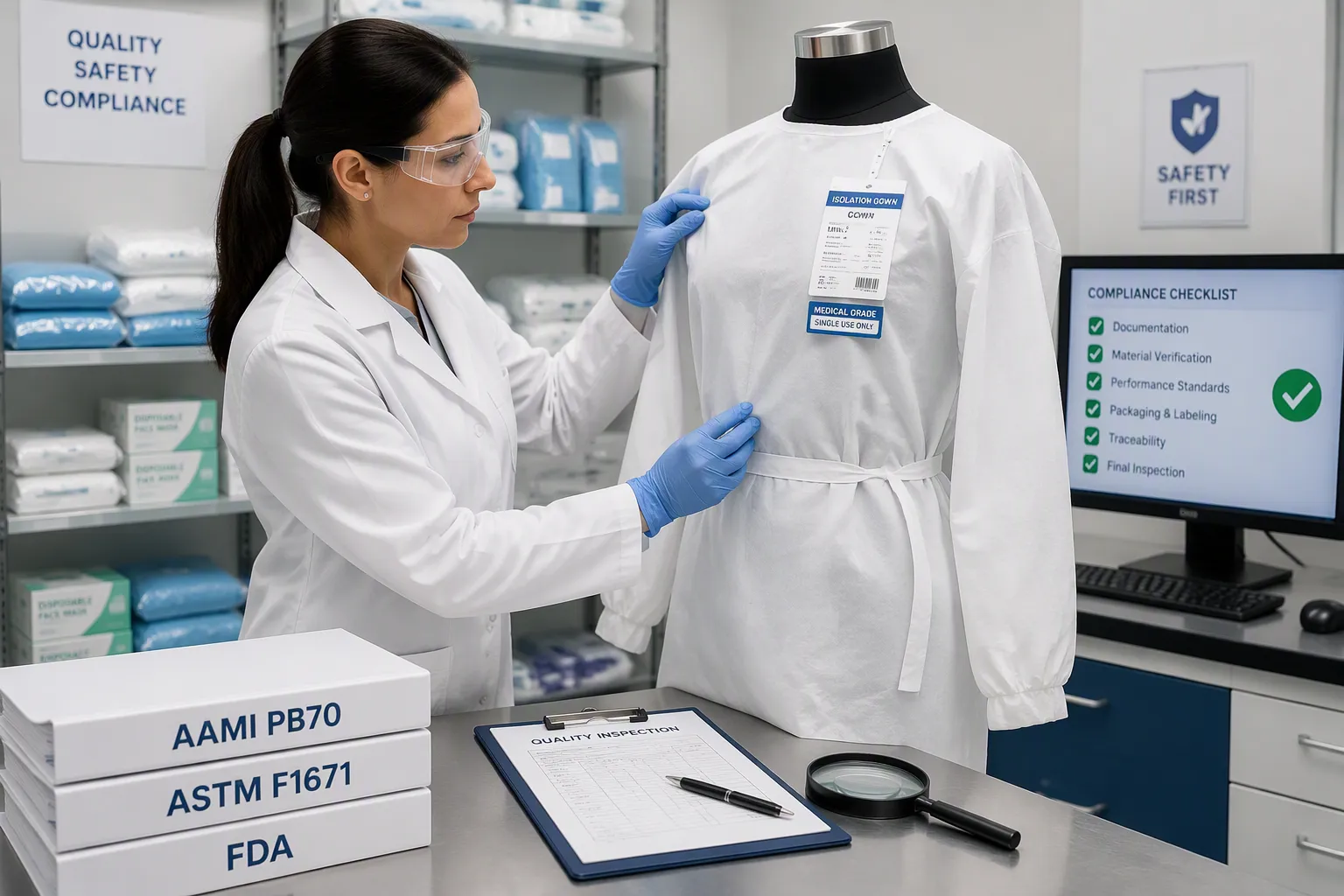
How to Verify an AAMI Level 4 Gown: PB70. Start with the PB70 classification. You must find a valid Level 4 rating set by ANSI/AAMI PB70. Next, look at the ASTM F1671 viral penetration test. The gown must pass at 2 psi. Last, check the FDA 510(k) clearance. It must list high-risk procedures as the intended use.
Supplier claims are easy to make but hard to check without the right ANSI standards. You need to know exactly what to ask for. This article goes through each step to verify. You will learn which documents to request, like the ASTM test report and FDA clearance letter. Watch for warning signs like missing test data and intended use that does not match surgical procedures.
Key Takeaways
Look for a real AAMI Level 4 rating on the gown’s label.
Ask for an ASTM F1671 test report that shows no virus got through at a pressure of 2 psi.
Check the FDA 510(k) clearance number and the intended use for high-risk procedures.
Make sure the test report comes from a lab that is accredited, such as SGS or Intertek.
Look out for warning signs, such as missing test data or reports that are out of date.
You need three documents: PB70 evidence, ASTM F1671 report, and FDA clearance.
Teach your team to spot false claims and check documents before you buy.
Check approved gowns every year to make sure they still meet the rules.
How to Verify an AAMI Level 4 Gown: PB70 Basics
The ANSI/AAMI PB70 standard makes the rules for how surgical gowns block liquids. This standard creates four levels of protection. Level 4 is the highest one. You need to understand this system before you trust what a supplier says. The AAMI PB70 standard gives you a shared way to compare products. It also gives you a way to check if a gown really meets its stated protection level.
The Four-Level Barrier System
The AAMI PB70 levels rank gowns by how well they block liquids. Each level uses its own tests. The results decide the rating. You should know what makes each tier different.
Levels 1 Through 3 at a Glance
Level 1 gowns face the lowest risk. They only need to pass the AATCC 42 impact penetration test. The blotter weight gain must stay at or below 4.5 g. No hydrostatic pressure test applies here.
Level 2 gowns must pass AATCC 127 with a minimum resistance of 20 cm. They also need AATCC 42 with a blotter weight gain at or below 1.0 g.
Level 3 gowns step up to 50 cm on the AATCC 127 hydrostatic pressure test. They share the same AATCC 42 requirement as Level 2.
AAMI Barrier Level | Hydrostatic Head Water Pressure Requirement |
|---|---|
Level 1 (Minimal Risk) | No hydrostatic pressure requirement |
Level 2 (Low Risk) | ≥ 20 cm H₂O |
Level 3 (Moderate Risk) | ≥ 50 cm H₂O |
Level 4 (High Risk / Viral) | Not hydrostatic; impermeable to Phi-X174 bacteriophage under 13.8 kPa pressure (ASTM F1670/F1671) |
What Makes Level 4 Different
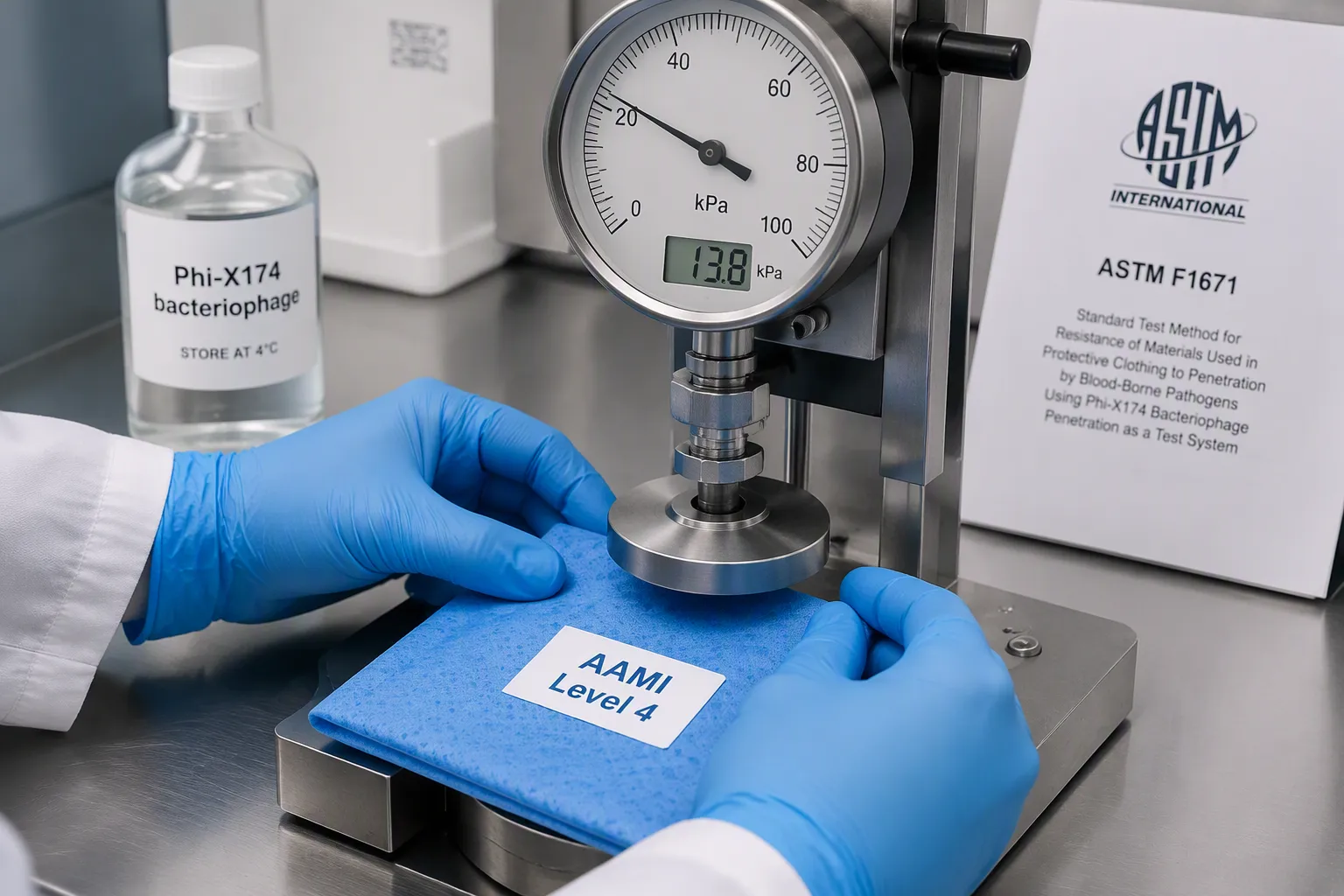
Level 4 does not use hydrostatic pressure testing at all. Instead, it needs a different kind of proof. The gown must pass ASTM F1671. This test uses bacteriophage Phi-X174 as the challenge agent. The gown must show zero penetration at 2 psi (13.8 kPa). ASTM F1670 uses synthetic blood for the same pressure check. Both tests must show zero penetration for a fabric to qualify for Level 4.
Only Level 4 gowns are tested for viral penetration resistance, and therefore only Level 4 garments are considered impermeable to viral penetration using ASTM F1671. The Level 4 criteria require no penetration at 2 psi (13.8 kPa) under ASTM F1670 (synthetic blood) for surgical drapes and ASTM F1671 (bacteriophage Phi-X174) for surgical and isolation gowns.
This difference matters for infection control. Level 4 gowns protect against bloodborne pathogens. They suit high-risk, fluid-intensive procedures and long surgeries. Only PB70 Level 4 gowns undergo evaluation for viral penetration resistance under ASTM F1671.
Reading the Gown Label
The label tells you what the manufacturer claims. You must know where to look and what counts as valid.
Locating the PB70 Classification
ANSI/AAMI PB70 requires the label to display its class of barrier performance. Look for the term “Level 4” or equivalent wording. This shows the gown meets PB70 Level 4 barrier requirements. If the back panel does not meet at least Level 1, the label must also carry the warning “Back is Non-Protective.”
What a Valid Level 4 Claim Looks Like
A valid claim names the standard. You want to see “ANSI/AAMI PB70” and “Level 4” together. The label should also point to ASTM F1671 testing. A claim without these references gives you nothing to verify.
Common Misconceptions
Buyers often accept claims that sound official but lack substance. Two errors appear again and again.
“Level 4” Without PB70 Reference
A gown marked “Level 4” alone means little. The number must tie back to the ANSI/AAMI PB70 standard. Without that link, you cannot confirm the test methods or the pass criteria. Treat the claim as unproven.
Confusing Gown Level with Other PPE Ratings
PB70 levels apply to gowns only. Do not mix them with ratings for masks, gloves, or eye protection. Each type of PPE follows its own standard. A high rating on one item says nothing about another. Keep your verification focused on the gown and its own documentation.
AAMI Level 4 and ASTM F1671 Compliance
ASTM F1671 is the key test for AAMI Level 4. A gown must pass this test on all parts that matter, like seams and attachments. The standard requires a barrier that blocks liquids across the whole critical zone. This rule separates real Level 4 products from gowns that only claim the rating.
What ASTM F1671 Measures
This test pushes a liquid with a virus stand-in through the fabric under pressure. It checks if any virus gets to the other side. The method gives you a clear answer about viral penetration resistance.
Bacteriophage Phi-X174 as the Test Organism
The test uses bacteriophage Phi-X174, a tiny virus about 27 nm wide. Researchers picked it as a virus stand-in because its size is like bloodborne pathogens. The table below shows the main test details.
Test organism | Pressure threshold |
|---|---|
2 psi (13.8 kPa) sustained for 1 hour with zero penetration |
Why Viral Penetration Resistance Matters
Blood and body fluids can carry viruses during surgery. A gown with weak viral penetration resistance puts surgeons and nurses at risk. This is why infection control teams treat Level 4 as the standard for high-risk, fluid-heavy procedures. The barrier must hold up for the whole length of long surgeries. Only Level 4 gowns get checked for viral penetration resistance, and only these garments count as impermeable under ASTM F1671.
ASTM F1671 Viral Penetration Test (for surgical and isolation gowns): Bacteriophage Phi-X174; no penetration at 2 psi (13.8 kPa). Only Level 4 gowns are tested for viral penetration resistance, and therefore only Level 4 garments are considered impermeable to viral penetration using ASTM F1671.
Reading the Test Report
A test report gives you the plain facts. You should know the pass rules and how to check the lab.
Pass/Fail Criteria and 2 psi Threshold
Level 4 requires no penetration at 2 psi (13.8 kPa) using bacteriophage Phi-X174. The pressure holds for 1 hour. Zero penetration means a pass. Any visible penetration means a fail. ASTM F1670 uses the same pressure check with synthetic blood penetration as the challenge. Both tests must show zero penetration for a fabric to qualify. A valid report lists the model, the AAMI rating, and the ASTM F1671 result. The example below shows what passing entries look like.
Gown Model | AAMI Rating | ASTM F1671 (Viral) Result |
|---|---|---|
Level 4 | ✓ Pass | |
IL-4036YKTP (36gsm) | Level 4 | ✓ Pass |
Verifying the Testing Laboratory
Check that an accredited lab ran the test. Names like SGS, TÜV, Intertek, and Nelson labs carry weight. Ask for the report number and confirm it with the lab. A report from an unknown lab with no traceable number gives you little confidence. The ASTM protocols only mean something when a qualified lab follows them.
Red Flags in Test Claims
Some suppliers describe testing that never happened. Others stretch old results to cover new products. Watch for these warning signs.
Missing Test Pressure Data
A real report states the pressure and the hold time. If a claim says “passed ASTM F1671” without the 2 psi figure, treat it as unproven. The same rule applies to synthetic blood penetration claims. Demand the full data set.
Expired or Outdated Reports
Test reports carry dates. An old report may not cover the fabric or factory you are buying from now. Ask for a report tied to the current production lot. Suppliers who cannot name their raw material source raise another concern. Vague phrases like “high-quality nonwoven” tell you nothing about barrier performance. Reputable suppliers share third-party reports from accredited labs. They also provide lot traceability from raw material to finished gown. A supplier who refuses a sample or hides quality control records fails the basic test of transparency.
Confirming FDA Documentation
FDA paperwork for AAMI Level 4 gowns shows the product follows ANSI/AAMI PB70 and passes ASTM F1671 testing. You need these papers to make sure the gown meets the standard. The FDA does not approve every gown sold in the market. Instead, makers must prove their product is basically the same as a device already legally sold. This process leaves a paper trail you can follow.
Finding the 510(k) Number
The 510(k) number is where you begin. This number connects the product to its FDA clearance. Without it, you cannot check what the maker claims.
Where It Appears on Labeling
Look for the FDA 510K number on the gown’s box or label. Makers often print it close to the product name or the company’s address. Some put it on the instructions for use. If you cannot find the number, ask the supplier for it.
What the Number Tells You
The 510(k) number proves the device went through FDA review. It shows the maker proved it is substantially the same as a predicate device. This number also lets you pull the clearance summary from the FDA database. A product without a 510(k) number may not have FDA clearance at all.
Searching the FDA Database
The FDA keeps a public database of cleared devices. You can search this database to confirm a gown’s clearance status. This step takes only a few minutes and gives you strong proof.
Search by Product Code and Applicant
Go to the FDA 510(k) Premarket Notification database through the Devices@FDA search on fda.gov. Run a search using one of several items, such as device name, applicant, 510(k) number, or product code. You can narrow results by using the Panel dropdown to browse review specialties. Pick a result to see details like the decision, decision date, regulation number, and often a link to the 510(k) summary PDF. A search query returns information in a structured format that includes the device classification name, regulation number, 510(k) number, device name, applicant, product code, date received, decision date, decision, and summary or statement. The result shows whether a summary or statement is provided.
Matching the Cleared Device to the Product
The cleared device must match the product in your hands. Check the model number, the maker name, and the intended use. A clearance for one model does not cover a different product. You can use a cleared device’s product code to find all other devices cleared under the same code. This approach is the fastest way to build a predicate device list.
Verifying Intended Use
The intended use statement tells you what procedures the gown is cleared for. You must read this language with care.
Language Confirming High-Risk Use
Look for phrases like “high-risk procedures,” “fluid-intensive procedures,” or “surgical gowns.” These terms confirm the gown is cleared for the high-risk settings where AAMI Level 4 protection matters. The FDA clearance must clearly cover these uses.
When Intended Use Does Not Match
Sometimes a gown has a 510(k) number but the intended use does not mention high-risk procedures. This mismatch is a red flag. The product may be cleared for a lower level of protection. Do not accept it for Level 4 applications. Ask for more documents or reject the product.
Practical Verification Checklist
You have learned the standards and tests. Now put that knowledge to use. This checklist gives you a step-by-step process for every gown.
The Three-Document Rule
You need three documents to verify a Level 4 gown. Collect all three before you approve it.
PB70 Classification Evidence
The first document shows the gown meets how to verify an aami level 4 gown: pb70 requirements. An FDA clearance gives you this proof. It shows the gown follows ANSI/AAMI PB70. It has test data from the finished gown at the end of its shelf life. For reusable protective gowns, testing happens after the most reprocessing cycles. Engineering drawings show the critical zones and the barrier performance level. Sample labels show liquid barrier performance based on ANSI/AAMI PB70.
ASTM F1671 Test Report
The second document is the ASTM F1671 test report. It must show a pass for viral penetration resistance. The gown stops bacteriophage Phi-X174 at 2 psi. Some suppliers give an ASTM F1670 report for synthetic blood penetration. Both tests back up the Level 4 claim. The report must come from an accredited testing lab. It must match your gown model.
FDA 510(k) Clearance Letter
The third document is the FDA 510(k) clearance letter. It proves the device met FDA rules. The letter mentions AAMI PB70 and ASTM testing protocols. Use the 510(k) number to search the FDA database. Make sure the cleared device matches your product. The clearance must cover high-risk procedures. Reject the gown if the intended use does not match.
Sourcing Tips for Procurement
Use a standard approach to get documents fast.
Questions to Ask Suppliers
Ask which standards apply. You need AAMI PB70, ASTM test requirements, and FDA regulatory information. Ask about ISO 13485 quality management. Request product test reports. Check that they match the actual product specs. Ask for a Declaration of Conformity. Make the regulatory status clear. Confirm the supplier controls raw materials and inspects finished products. For reusable protective gowns, ask about labeled use-life and reprocessing cycles.
Requesting Documentation Without Delays
Ask for the right documents in your first email. Name the FDA 510(k) number, the ASTM F1671 test report, and PB70 evidence. Ask for the gown model number and manufacturer name. Set a clear deadline. Follow up if you need to.
Common Pitfalls
Stay away from these mistakes.
Accepting Marketing Language as Proof
Marketing phrases like “fluid-resistant” are not the same as a stated AAMI PB70 level. You need the level number, test method, critical zone coverage, and regulatory status. “Isolation gown” is a category, not a barrier level. Choosing lower gown levels shifts risk to your staff. Critical-zone-only coverage means the whole garment is not protected. FDA clearance and AAMI PB70 level are different claims.
Relying on Self-Declared Compliance
Self-declared compliance is not enough. You need third-party testing and FDA clearance. FDA clearance includes proof of compliance with AAMI PB70 and ASTM protocols. Check the intended use and barrier performance data. A supplier without test reports is not being open. Reject the product until they give you the right documents.
When Documentation Falls Short
Sometimes a supplier cannot give you the papers you need. The gap may be small or large. Either way, you must act with care. Weak paperwork leaves you with no proof of barrier performance. It also puts your staff at risk.
Requesting More Evidence
Ask for more proof before you decide. A polite, firm request often solves the problem fast.
Third-Party Test Reports
Ask for a full ASTM F1671 report from an accredited lab. The report must name your gown model and show a pass at 2 psi. Ask for the ASTM F1670 synthetic blood result too. Both tests support a Level 4 claim. A summary sheet is not enough. You need the raw data, the lab name, and the report number. For reusable protective gowns, ask for ASTM testing after the maximum reprocessing cycles. This step confirms the barrier holds up over the labeled use-life. A report tied to the current production lot gives you the strongest proof.
Direct Manufacturer Communication
Contact the maker, not just the seller. Ask for the FDA 510(k) number and the ANSI/AAMI PB70 evidence. A real maker will answer with documents. A trader who cannot reach the factory will stall. Ask about ISO 13485 quality systems and raw material controls. These details show the maker runs a real quality program. Ask which ASTM protocols apply to each critical zone. This question separates a prepared maker from one who guesses.
When to Reject a Product
Some gaps are too big to fix. Walk away when the paperwork fails these checks.
Incomplete or Inconsistent Documentation
Reject the gown when the documents do not line up. The table below lists the failures that justify a rejection.
Documentation Inconsistency | Why It Justifies Rejecting an AAMI Level 4 Claim |
|---|---|
No valid 510(k) clearance under FYC, FYA, or QPC | A Level 4 claim legally requires premarket clearance |
Reliance on establishment registration as “approval” | Registration does not denote FDA approval |
Use of vague “procedure gown” terminology | FDA treats such gowns as surgical gowns requiring 510(k) review |
Failure to state the exact barrier level in labeling | Vague claims cannot substantiate Level 4 |
Open-back design lacking full critical zone coverage | Critical zones must cover the entire garment |
Citing expired COVID-19 EUAs | Emergency flexibilities no longer authorize non-cleared gowns |
Reporting Suspected Mislabeling to the FDA
Report the product when a supplier mislabels it. The FDA runs a portal for suspected mislabeling. Send the 510(k) number, the label photo, and your test data. This step protects other healthcare personnel. It also supports infection control across the market. Strong compliance starts with buyers who speak up. Your report helps infection control teams everywhere.
Building Ongoing Gown Compliance
Checking a gown is not a one-time job. It is a constant process that keeps your staff and your company safe. You must set up systems that keep your gown compliance strong over time. This part shows you how to record your work and make suppliers answer for their claims.
Documenting Your Verification Process
Your verification work must leave a clear trail. An auditor will ask for proof that you checked each gown before use. A well-organized file answers every question before it comes up.
Keeping Audit-Ready Records
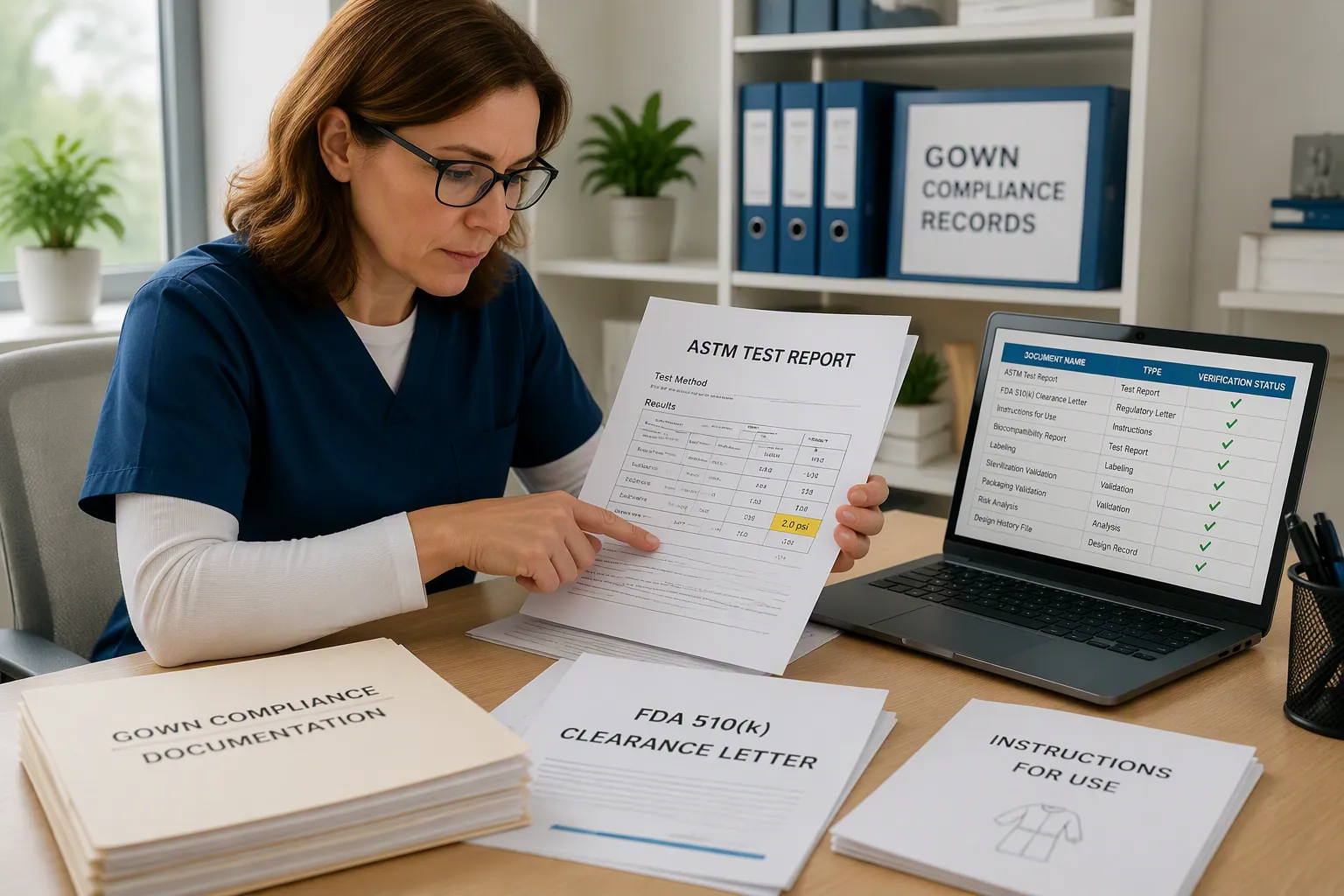
Keep the documents in one file you can show an auditor. Good files include the ASTM test report, the FDA 510(k) clearance letter, and the maker’s instructions for use. You can see an example of an IFU for an AAMI Level 4 decontamination gown on the HMark website. The file also belongs in your buying records. Write down the gown model, the supplier, and the date you checked it.
Document Name | Document Type | What to Check |
|---|---|---|
Protective Equipment Brochure | Product Brochure | Checks that the gown model and intended use match your order |
AAMI Level 4 Decontamination Gown IFU | Instructions for Use | Confirms barrier performance and reprocessing cycles for reusable protective gowns |
AAMI Level 4 Decontamination Gown Flyer | Marketing Material | Lists the AAMI rating and the test data that supports it |
Keep these records for as long as you use the product and after. Update the file when you get a new lot or a new test report. Mark the file as “verified” only when you have all three required documents. This habit saves time during inspections. It also shows your infection control policies are active, not just written down.
Training Staff on Verification Steps
Your staff must know what to look for. Hold a training session that walks through the three-document rule. Show them how to find the PB70 classification on the label. Show how to check the ASTM test report for the 2 psi threshold. Let them practice searching the FDA database. Cover the red flags like missing test pressure data or expired documents. Use the certification steps you followed during your first check as a model. Run this training once a quarter or whenever you approve a new supplier. Your team then becomes a strong defense against bad paperwork. They can spot problems before a gown reaches the operating room. This approach makes your overall infection prevention compliance stronger.
Holding Suppliers Accountable
Suppliers respond to what you demand. If you always ask for the right documents, they will give them to you. If you accept weak paperwork, they will keep sending it.
Contract Language Requiring Evidence
Put a rule for documents in every purchase agreement. Write that the supplier must give a current ASTM test report for each gown lot. State that the report must come from an accredited lab. Also require an FDA 510(k) number that matches your product. Add a clause that lets you reject any gown without this proof. Name the exact ANSI and ASTM standards in the contract. You can also ask the maker for a declaration of conformity. This wording creates clear compliance rules for every new order. It also sets expectations for reusable protective gowns, which need test reports after the most reprocessing cycles. Your contract then does the enforcement work for you.
Periodic Re-Verification of Approved Products
A verified gown can lose its status. The maker may change the fabric or the factory. The FDA may update its clearance language. You need a plan to catch these changes. Schedule a re-verification check once a year. Pull the approved product file and confirm each document is still current. Call the supplier and ask if anything changed. Request a new ASTM test report for the latest production lot. Follow the same written inspection steps you used the first time. This step catches drift before it becomes a compliance gap. It also shows your infection control team that you stay active in watching products. Your re-verification procedure should match your first check step for step. Consistency builds trust in your whole quality system.
How to verify an AAMI Level 4 gown: PB70 classification, a passing ASTM F1671 test report, and FDA 510(k) clearance are your three evidence pillars. You must always request these three documents before approving any gown for use. Your verification work protects patients, staff, and your organization’s compliance standing. Strong infection control starts with documented proof that meets ASTM standards. Active control of your documentation process ensures your product choices stay valid over time. Make documentation review a standard step in every PPE procurement decision. Your team and patients depend on this simple routine. Each document you check confirms the product will perform as needed in high-risk settings. Do not accept claims without written proof from accredited labs. Verification is your best defense against poor product decisions.
FAQ
What is the difference between AAMI Level 3 and Level 4 gowns?
Level 3 gowns must pass the AATCC 127 hydrostatic pressure test at 50 cm. Level 4 gowns skip that test. Instead, they must pass the ASTM F1671 viral penetration test with zero penetration at 2 psi (13.8 kPa).
Which test organism does ASTM F1671 use?
The test uses bacteriophage Phi-X174. This virus measures about 27 nm wide. Researchers chose it because its size resembles bloodborne pathogens. The gown must block this organism at 2 psi for one hour with zero penetration.
Can a gown claim Level 4 without an ASTM F1671 report?
No. A valid Level 4 claim requires a passing ASTM F1671 test report. The report must come from an accredited lab and match your gown model. A claim without this document gives you nothing to verify.
Where do I find the FDA 510(k) number?
Look on the gown’s box, label, or instructions for use. Makers often print it near the product name or company address. If you cannot find it, ask the supplier directly.
What does the FDA 510(k) number prove?
The number shows the device went through FDA review. It proves the maker demonstrated substantial equivalence to a predicate device. You can use this number to pull the clearance summary from the FDA database.
What should I do if a supplier cannot provide test reports?
Request a full ASTM F1671 report from an accredited lab. Ask for the raw data, lab name, and report number. If the supplier still cannot deliver, reject the product. Weak paperwork leaves you with no proof of barrier performance.
How often should I re-verify an approved gown?
Schedule a re-verification check once a year. Pull the approved product file and confirm each document is still current. Call the supplier and ask if anything changed. Request a new test report for the latest production lot.
What are common red flags in gown documentation?
Watch for missing test pressure data, expired reports, and vague terms like “fluid-resistant.” A “Level 4” claim without an ANSI/AAMI PB70 reference means little. Also check that the FDA intended use mentions high-risk procedures.